21 Jul 2026
NGC 5139 — The Globular King
NGC 5139 — The Globular King
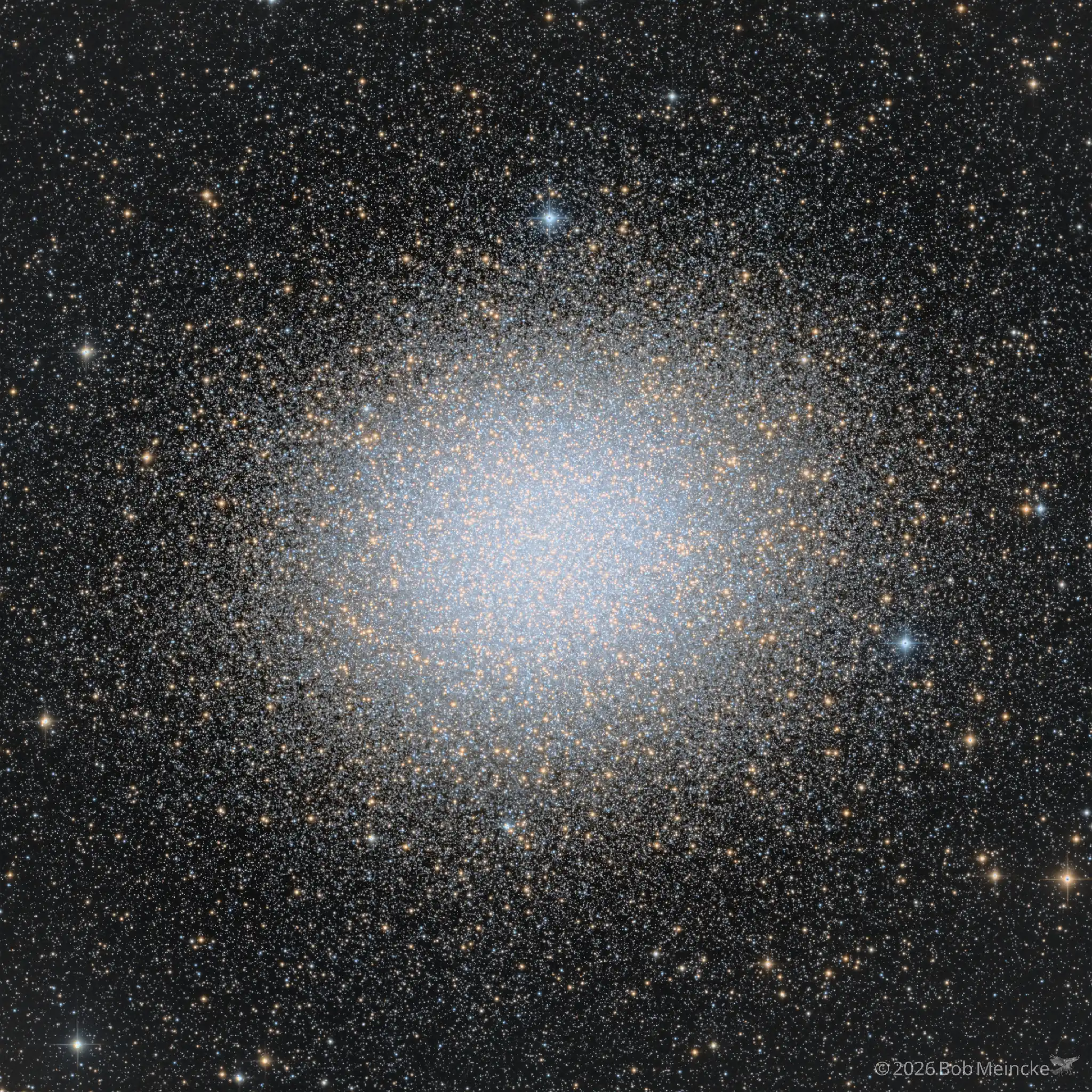
Towering over every other globular cluster in the Milky Way, NGC 5139, better known as Omega Centauri, truly earns the title The Globular King. Containing an estimated 10 million stars, spanning nearly 150 light-years, and located approximately 15,800 light-years from Earth in the constellation Centaurus, it is by far the largest and most massive globular cluster in our galaxy.
Yet Omega Centauri may not be a globular cluster at all.
Its unusually broad range of stellar ages and chemical compositions has led many astronomers to conclude that it is actually the surviving nucleus of a dwarf galaxy that ventured too close to the Milky Way billions of years ago. Over countless orbits, our galaxy stripped away nearly everything, leaving behind only this brilliant stellar heart—a royal remnant of a once-independent galaxy.
To capture the extraordinary dynamic range of this object, I combined multiple exposure lengths for every LRGB channel using HDRComposition in PixInsight. This preserved detail from the brilliant central core all the way to the faint outer halo, allowing the dense heart of the cluster to remain resolved instead of becoming a featureless glow. A carefully blended luminance layer then enhanced stellar separation while preserving the natural color of the stars.
Looking into Omega Centauri is unlike looking at most deep-sky objects. There are no glowing clouds of gas or delicate spiral arms—only an overwhelming sea of ancient suns packed together in numbers that challenge comprehension. Every point of light is a star, and together they form one of the oldest and grandest surviving structures in our galactic neighborhood.
Some rulers inherit a crown.
Others earn one.
NGC 5139 has worn its crown for billions of years.
NGC 5139
9 credit