07 Aug 2026
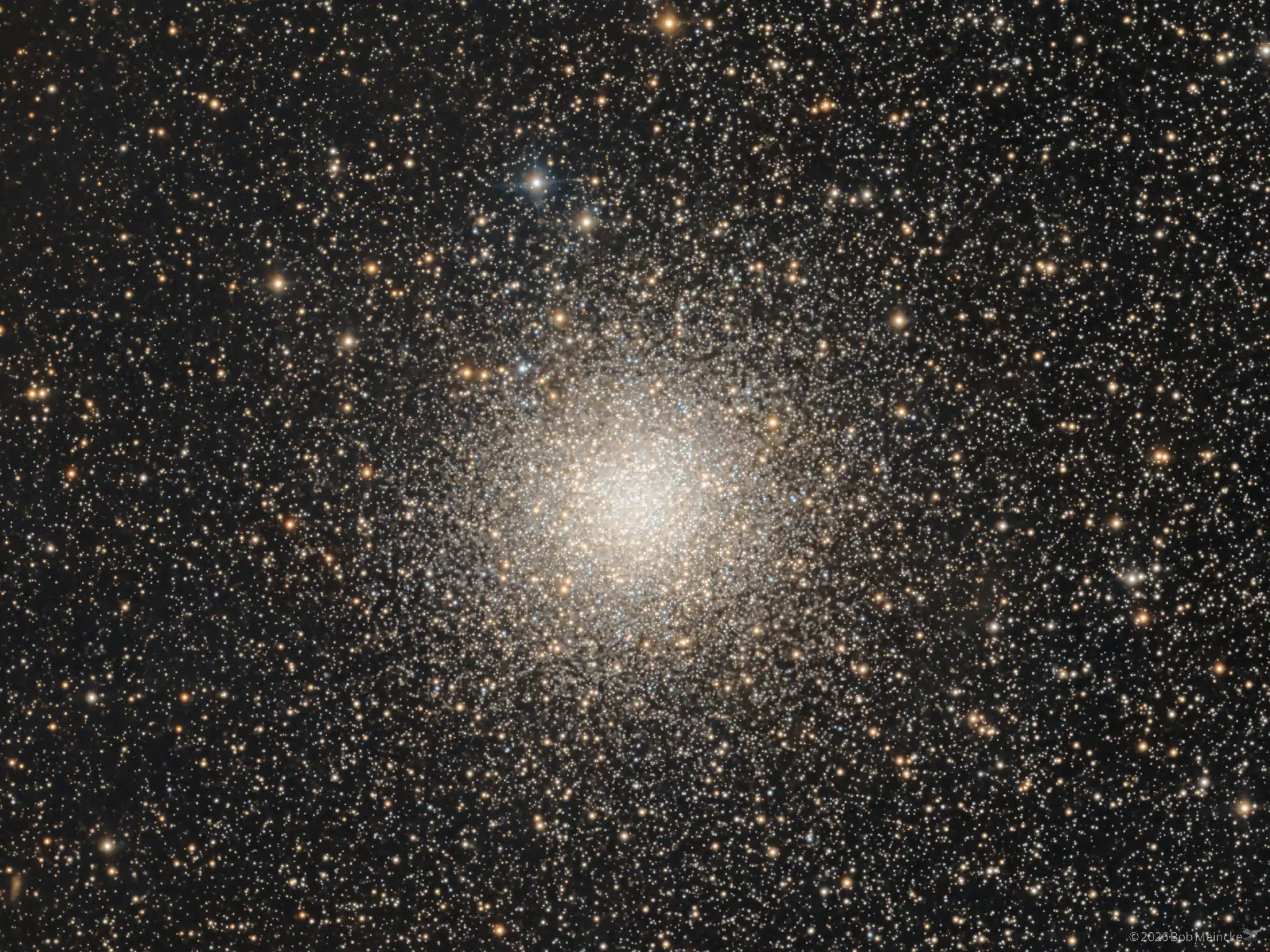
M9 — Metal Poor — Star Rich
M9 — Metal Poor — Star Rich
Long before the Milky Way became enriched with the heavier elements that build planets—and eventually life—M9 was already shining. Its stars contain only a fraction of the "metals" found in younger stellar populations, marking it as one of our Galaxy's ancient survivors. Yet what it lacks in heavy elements, it more than makes up for in numbers. Hundreds of thousands of stars crowd together in this compact globular, their individual points of light merging into the soft glow of one of the Milky Way's oldest stellar cities.
Charles Messier added M9 to his catalog in 1764, though he could not resolve it into individual stars, describing it simply as a nebula without stars. Decades later, William Herschel, using his far larger telescopes, resolved the cluster into countless faint suns, revealing its true nature and transforming it from a hazy patch into a vast spherical congregation of ancient stars.
Today we know M9 lies about 25,800 light-years away in the constellation Ophiuchus and is one of the Milky Way's oldest globular clusters, preserving a stellar population that has changed little over the last 12 billion years.
M9
3 credit