29 May 2024
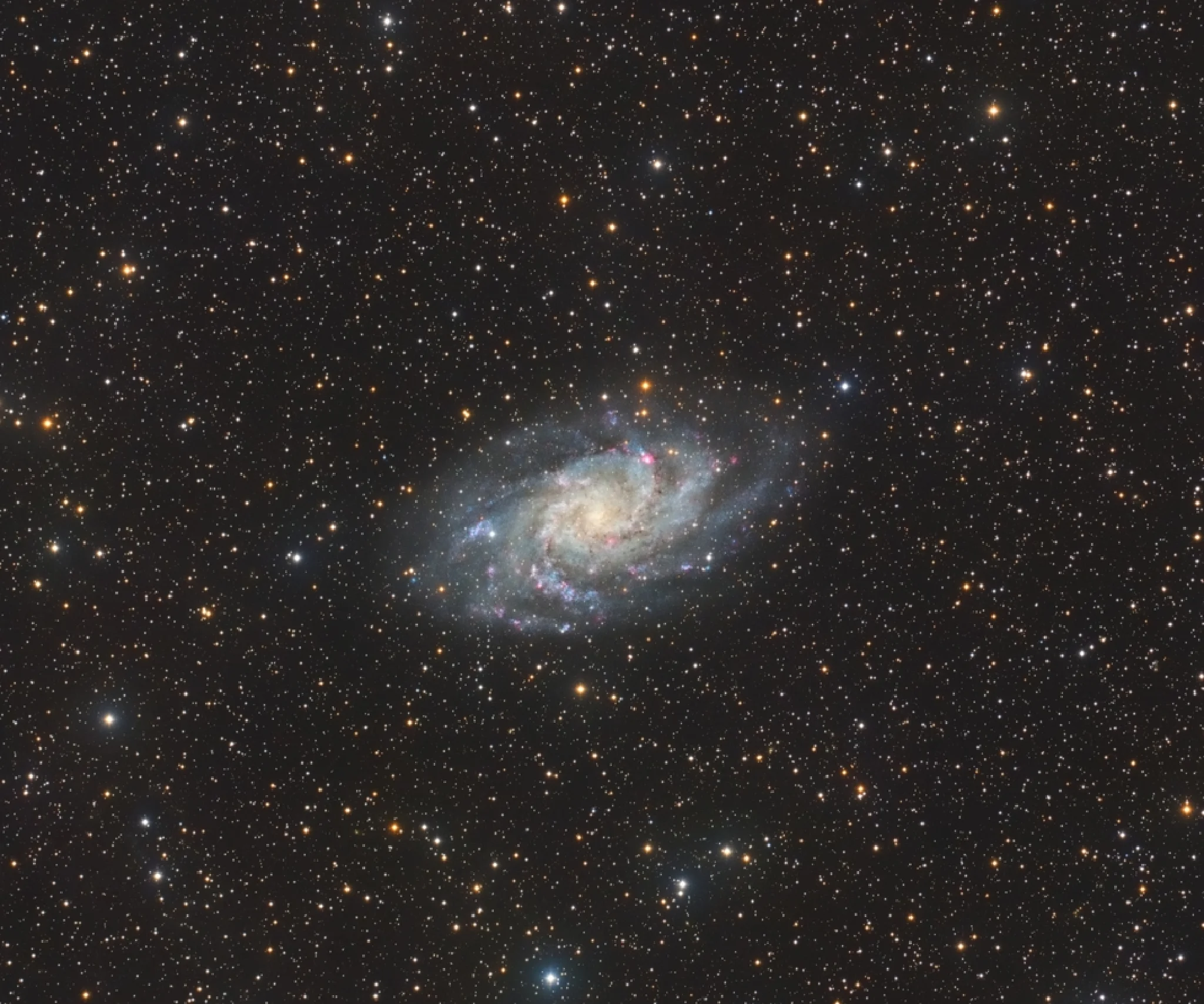
Messier 33 - Triangulum Galaxy
Messier 33 / Triangulum Galaxy is the third largest galaxy in the Local Group, after Andromeda and the Milky Way. It is located 2,73 million light-years away in the constellation which gives its name. It has a diameter of 61.000 light-years and an apparent magnitude of +5,7 – in very dark, clear skies, it can be seen with the naked eye as a diffuse cloud.
Most likely, the galaxy was first observed by the Italian astronomer Giovanni Batista Hodierna before 1654, but Messier was the first to officially catalogue it in 1764. M 33 is a spiral galaxy with loose arms, rich in star-forming regions and dust. The nucleus is a HII region, where the star forming rate is even higher than the one in Andromeda Galaxy. M 33 doesn’t have a supermassive black hole in its center, like most galaxy have. Moreover, the stars in the nucleus have a different age than those in the arms, suggesting 2 separate star-forming stages.
Between M 33 and the Andromeda Galaxy there are multiple streams of neutral hydrogen (HI), suggesting a past interaction between the two. It looks like M 33 will merge with the result of the collision between Andromeda and the Milky Way, but the timeframe is not yet very well defined.
Andromeda Galaxy
25 credit