26 Jun 2025
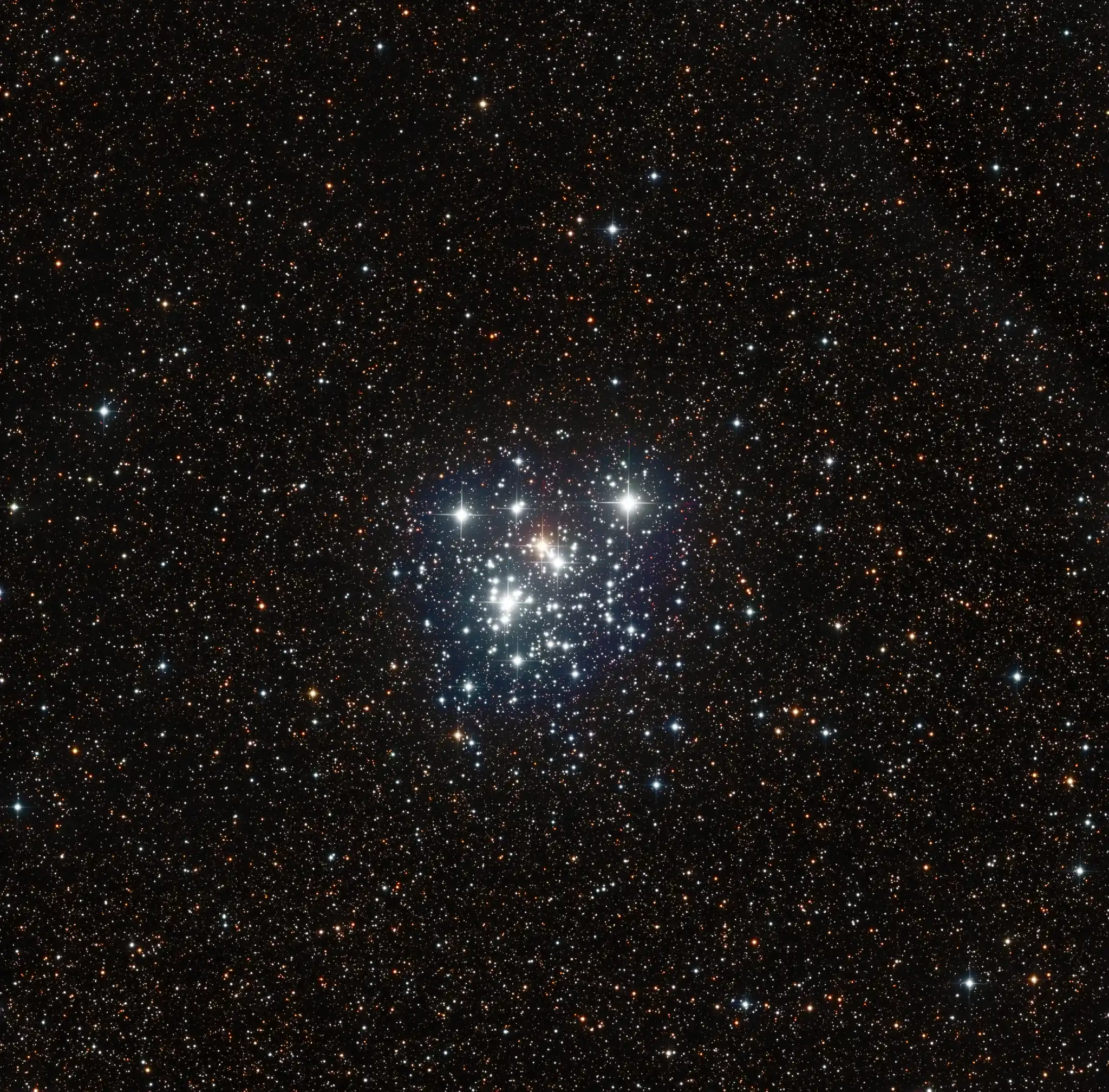
Jewel Box Cluster
The Jewel Box (also known as the Kappa Crucis cluster, NGC 4755, or Caldwell 94) is an Open cluster in the constellation Crux, originally discovered by Nicolas Louis de Lacaille in 1751–1752. This cluster was later named the Jewel Box by John Herschel when he described its telescopic appearance as "... a superb piece of fancy jewellery". It is easily visible to the naked eye as a hazy star some 1.0° southeast of the first-magnitude Mimosa (Beta Crucis). This hazy star was given the Bayer designation "Kappa Crucis", from which the cluster takes one of its common names. The modern designation Kappa Crucis has been assigned to one of the stars in the base of the A-shaped asterism of the cluster.
This cluster is one of the youngest known, with an estimated age of 14 million years. It has a total integrated magnitude of 4.2, is located 1.99 parsecs, or 6497 light years from Earth, and contains just over 100 stars.
A glorious cluster in binoculars of all sizes, it is also spectacular at low powers in a modest-sized (8-12") dobsonian telescope. The rich, red color of the “jewel star”, is a stunning contrast to the blue-white colors of the other bright cluster members. I have observed the object visually with my Canon IS 15x42 binoculars from the OzSky Star Party near Coonabarabran, NSW, Australia as well as with an 18" & 25" dob at the same star party.
This image is an 1800x1800 jpg crop of my final full size 3021x2974 LRGB PixInsight xisf file. There are faint traces in the full size image of the off-axis diagonal band of light created by the star Beta Crucis towards the upper right corner and I struggled mightily with my limited skills trying to eliminate that pesky glow. Additionally, I tried using the mono LRGB workflow diagram as formulated by Philippe Bernhard, but couldn't make sense of how to process the starless LUM and starless RGB images and wound up with very ugly results. So... I reverted to the workflow I was taught initially by my friend Jim F. with a couple of very slight alterations to the workflow. I think my star colors here are better than in my 47 Tucanae result (which I intend to reprocess).
Telescope (a Telescope Live unit):
Planewave CDK24 located in the Rio Hurtado valley, Chile at the El Sauce Observatory.
3962mm focal length, Astrodon filters
Mathis MI-1000/1250 mount
Camera:
FLI (Finger Lakes Instruments) PL 9000
12 micrometer pixels in a 3056x3056 array, 0.62 arcsec/pixel resolution
Acquisition:
Raw images captured on 13 separate nights in March, April, May, June, July & August of 2021
All raws were 600 second exposures, binned 1x1
15 Blue, 17 Green, 15 red & 18 Luminance for a total integration of 10 hours 50 minutes
No raws were rejected in the weighted batch preprocessing stage.
Software:
PixInsight, GraXpert, BlurXterminator, NoiseXterminator, GIMP (for jpg processing)
Enjoy!
Gordon
NGC 4755
9 credit