07 Jul 2025
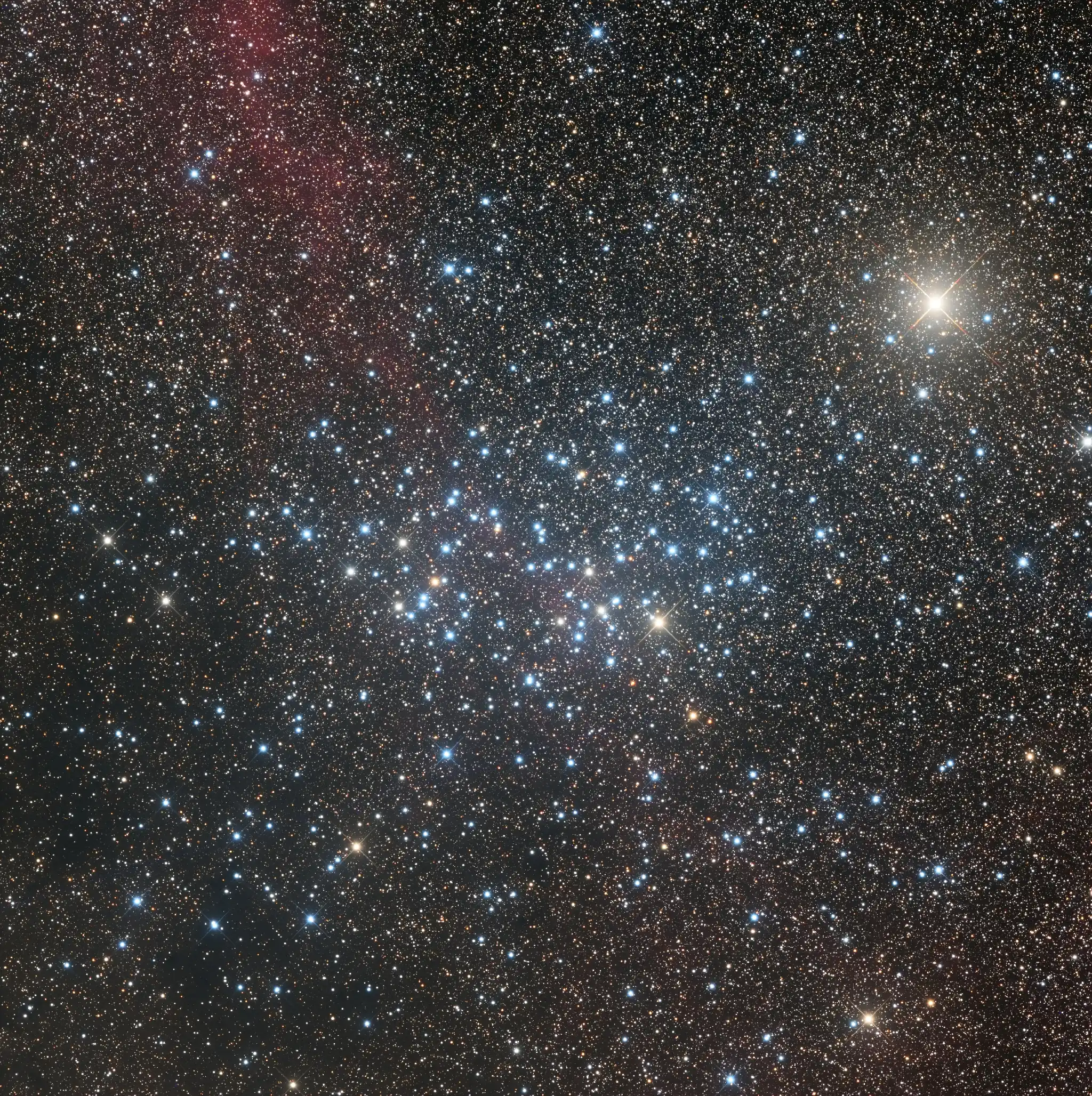
Wishing Well Cluster - NGC 3532
Among the many “jewels” in the southern constellation of Carina we can find a wonderful open cluster – NGC 3532 – which is known as the “Wishing Well Cluster”. It’s not very hard to understand why when we see the myriads of colorful stars spread on a relatively big area. This is another one of Lacaille’s discoveries (1751) that stands out in the sky at an apparent magnitude of +3. The cluster is elongated E-W and is a fine binocular object, covering about 50 minutes of arc.
NGC 3532 is about 2,4° ENE from the majestic Carina Nebula and it was the first object imaged by the Hubble Space Telescope in 1990, nearly a month after its launch. This cluster was, of course, the bringer of bad news about the incorrectly shaped mirror of HST.
The number of stars is not very well known, ranging from 150 to over 750. One problem would be that NGC 3532 lies in the thicket of the Milky Way, and its low-mass stars are lost against the rich galactic background. Recent photometry studies in broadband and infrared have shown that the cluster lies 1.600 light-years from the Sun and exhibits very little extinction despite its location in the galactic plane. Its age is estimated at 300 million years and the metallicity is near solar. Being middle-aged, its brightest stars are split between blue-white stars, which are still in the main sequence, and red-orange stars, which are heading towards the end of their life.
The variable star x Carinae lies at about 26 minutes of arc from NGC 3532, being a nice presence in a wide field capture. Its magnitude varies between +3,77 and +4,05 but the period is still uncertain. This is the brightest yellow hypergiant in the sky, and it’s no wonder – it is 500 times larger than the Sun and it radiates 200.000 times more luminosity.
NGC 3532
1 credit