14 Jul 2025
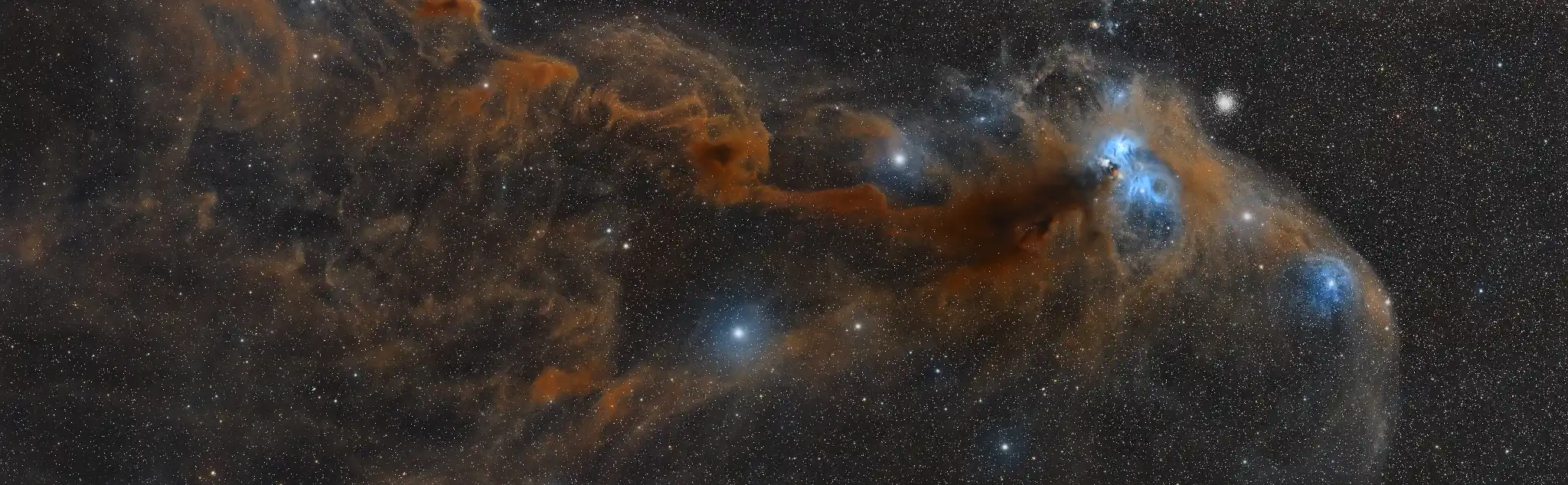
IC 4812 - Corona Australis Nebula - 2 Panel Mosaic
IC 4812 is a faint reflection nebula embedded in the rich star‑forming region of the Corona Australis Molecular Cloud, located in the southern constellation Corona Australis. The nebula spans about 10' × 7' on the sky and lies roughly 500 ly (≈160 pc) from Earth.
It was discovered by DeLisle Stewart on 4 August 1899 atop Harvard’s Arequipa station using a 24" Bruce refractor. IC 4812 illuminates and obscures light from foreground double stars HD 176269/70 (BSO 14), and forms part of the Coronet Cluster complex, a site of ongoing star formation with young stars, Herbig–Haro objects, and clumpy dust structures.
Two‑panel LRGB mosaic captures IC 4812’s subtle blue-gray reflection glow against the dark molecular cloud filaments, while seamlessly connecting to the surrounding structures: the reflection nebulae NGC 6726/7, emission/reflection fan‑shaped NGC 6729, and the dark thread of Bernes 157. At 2x panel scale, we can reveal both large‑scale dust architecture and fine detail in the nebular glow - showcasing the complexity and beauty of this nearby star‑formation laboratory.
IC 4812 - Panel 2
5 credit