04 Aug 2025
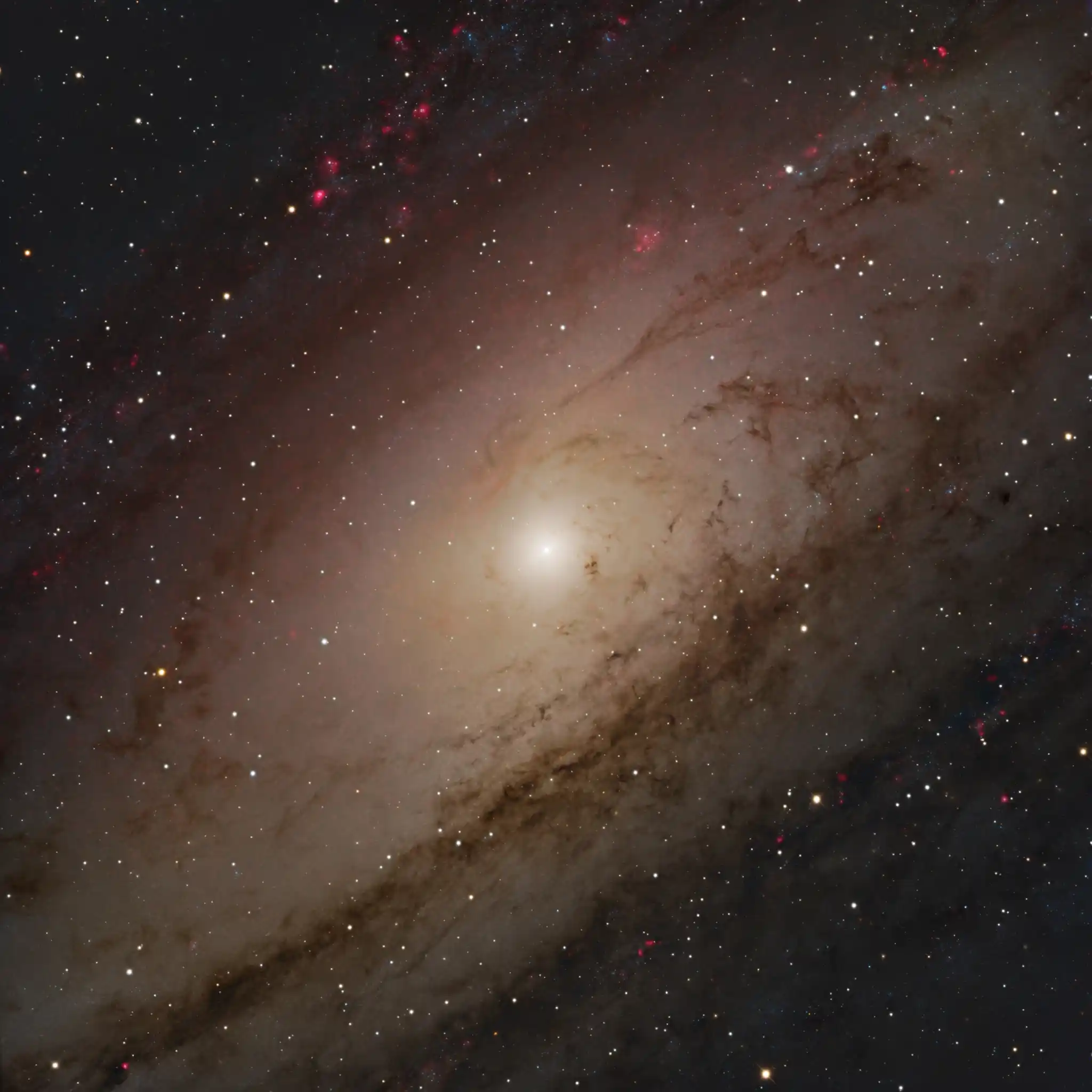
M31 - Core of Andromeda in HaLRGB
The core of M31 (NGC 224, PGC 2557) in Andromeda lies about 2.5 million light-years away and shines around mag ~3.1–3.4 overall, though only the bright bulge is visible to the naked eye. It hosts a famous double nucleus (P1/P2) orbiting a ~140-million-solar-mass black hole, along with a small blue stellar disk nested inside the older red bulge - features first clarified with Hubble. In Ha, the dust lanes and inner star-forming structures around the nucleus stand out strongly, while nearby companions M32 and M110 sit just off the core in wide-field views.
This dataset was captured with a 70 cm telescope from Telescope Live in HaLRGB, a filter set that balances natural color with enhanced H-alpha contrast to emphasize ionized gas and dust silhouettes crossing the bulge. Only about 1 hour of Ha data was available, which caused some minor challenges when integrating it with the LRGB set, but I hope the final image still conveys the dynamical complexity of our nearest giant spiral - an active, evolving center rather than a smooth, featureless glow.
Sources:
wikipedia.org
astropixels.com
science.nasa.gov
science.nasa.gov
skyandtelescope.org
Data credit: Telescope.Live
Andromeda Galaxy
16 credit
- Tipo di obiettivo............................................................................................................................Galaxy
- Fotocamera............................................................................................................................FLI PL16803
- Coordinate dell'obiettivo............................................................................................................................RA 10.6847 Dec 41.2688
- Emisfero............................................................................................................................Northern
- Posizione del telescopio............................................................................................................................Spain
- Evento transitorio............................................................................................................................No
- Osservato il............................................................................................................................01 Dec 2019 - 07 Jun 2022
Filtro | Exp. media (s) | Esposizione totale | Sottoframe |
|---|---|---|---|
| Luminance | 46 | 2h6m | 163 |
| Blue | 35 | 1h34m | 162 |
| Green | 62 | 2h48m | 162 |
| Red | 63 | 2h51m | 162 |
| Halpha | 22 | 1h | 162 |