05 Sept 2025
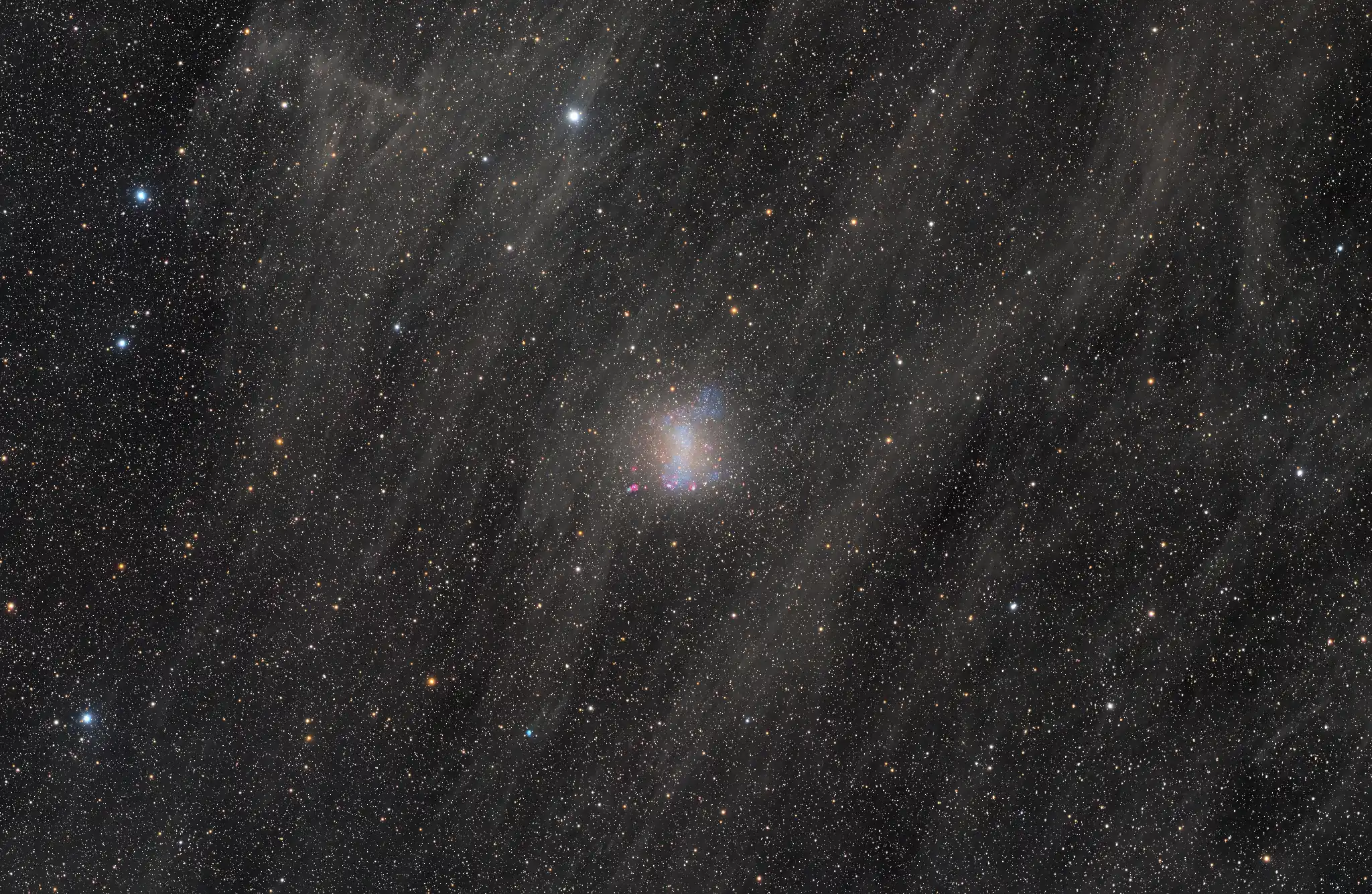
NGC 6822 - Barnard's Galaxy
This wide-field view captures NGC 6822, also known as Barnard’s Galaxy (Caldwell 57), a barred irregular dwarf located approximately 1.6 million light‑years from Earth in Sagittarius. As one of the Milky Way’s nearest non-satellite neighbors and a member of the Local Group, it spans roughly 7,000 light‑years across. First discovered by E. E. Barnard in 1884, this galaxy played a pivotal role in Edwin Hubble's early extragalactic work - he identified Cepheid variables in NGC 6822, helping confirm the existence of galaxies beyond the Milky Way. The galaxy contains a host of giant H II regions, notably Hubble‑V, a star-forming nebula about 200 light‑years in diameter and one of the most luminous stellar nurseries in the Local Group. More than 150 emission nebulae have since been catalogued, painting a vivid portrait of ongoing stellar creation. Despite its proximity, NGC 6822 features very low metallicity, similar to early-universe galaxies, making it an ideal laboratory for understanding galactic evolution and star formation in primitive conditions.
The image also presents a small, blue-hued planetary nebula tucked near the bottom center of the frame - NGC 6818, nicknamed the "Little Gem Nebula," at an approximate distance of ~6,000 light‑years. With an apparent diameter of around 20 arcseconds (~0.5 light‑years), it features a bright, vase-shaped inner bubble enveloped by a more diffuse outer shell, lined with knotty filamentary structures and vivid "blowouts" at the poles driven by fast stellar winds from its central star.
Data from Telescope Live's Australian site, using Takahashi FSQ 106ED. 10 hours of LRGB exposure.
Sources:
en.wikipedia.org
science.nasa.gov
www.esa.int
en.wikipedia.org
science.nasa.gov
Data credit: Telescope.Live
NGC 6822
7 credit
- Tipo di obiettivo............................................................................................................................Galaxy
- Fotocamera............................................................................................................................QHY 600M
- Coordinate dell'obiettivo............................................................................................................................RA 296.2342 Dec -14.7976
- Emisfero............................................................................................................................Southern
- Posizione del telescopio............................................................................................................................Australia
- Evento transitorio............................................................................................................................No
- Osservato il............................................................................................................................09 Sept 2023 - 12 Sept 2023
Filtro | Exp. media (s) | Esposizione totale | Sottoframe |
|---|---|---|---|
| Blue | 300 | 2h30m | 30 |
| Red | 300 | 2h30m | 30 |
| Luminance | 300 | 2h30m | 30 |
| Green | 300 | 2h30m | 30 |