27 Oct 2025
NGC 7822 HSOLRGB
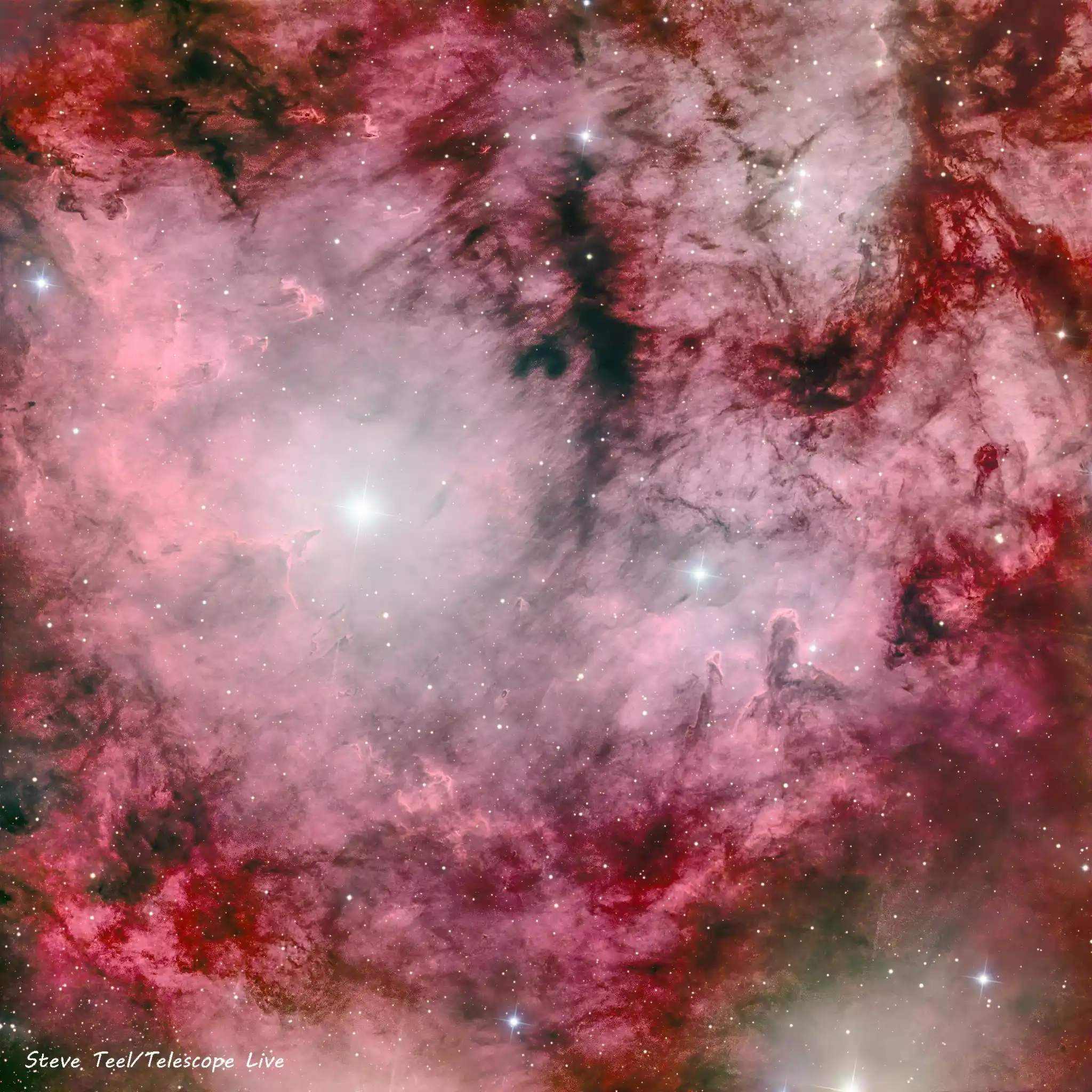
Think of this as a possible case for HSOLRGB data. Note that so far, the posts are SHO Hubble images with RGB stars. Obviously, that approach is hard to beat. But I have to wonder what the L data and even the large amount of RGB data is buying? As I began to process this image it wasn't clear that the HSOLRGB effort would produce anything worthwhile.
Charles Hagen points out in the Advanced Narrowband Combination topic on his NightPhotons website that in images of galaxies, adding Ha data to LRGB data adds, in essence, details regarding emission nebulae to existing details from star clouds. Here I observed that the HSO data is adding emission nebula detail to reflection nebulae.
This portion of NGC7822 is the heart of Cederblad 214 which formed an expanding cluster of stars among which is the newer cluster Berkeley 59 which appears in this image. Reflected light from the brightest stars shows up as a desaturation of the HII clouds.
NGC 7822
30 credit
- Tipo di obiettivo............................................................................................................................Emission Nebula
- Fotocamera............................................................................................................................FLI Proline PL16803
- Coordinate dell'obiettivo............................................................................................................................RA 0.2858 Dec 67.4214
- Emisfero............................................................................................................................Northern
- Posizione del telescopio............................................................................................................................United States of America
- Evento transitorio............................................................................................................................No
- Osservato il............................................................................................................................29 Oct 2022 - 25 Nov 2022
Filtro | Exp. media (s) | Esposizione totale | Sottoframe |
|---|---|---|---|
| Luminance | 3130 | 20h | 23 |
| Red | 2348 | 15h | 23 |
| Green | 2455 | 15h | 22 |
| Blue | 2455 | 15h | 22 |
| SII | 3273 | 20h | 22 |
| Halpha | 3273 | 20h | 22 |
| OIII | 3270 | 19h59m | 22 |