13 Nov 2025
Orion's Belt
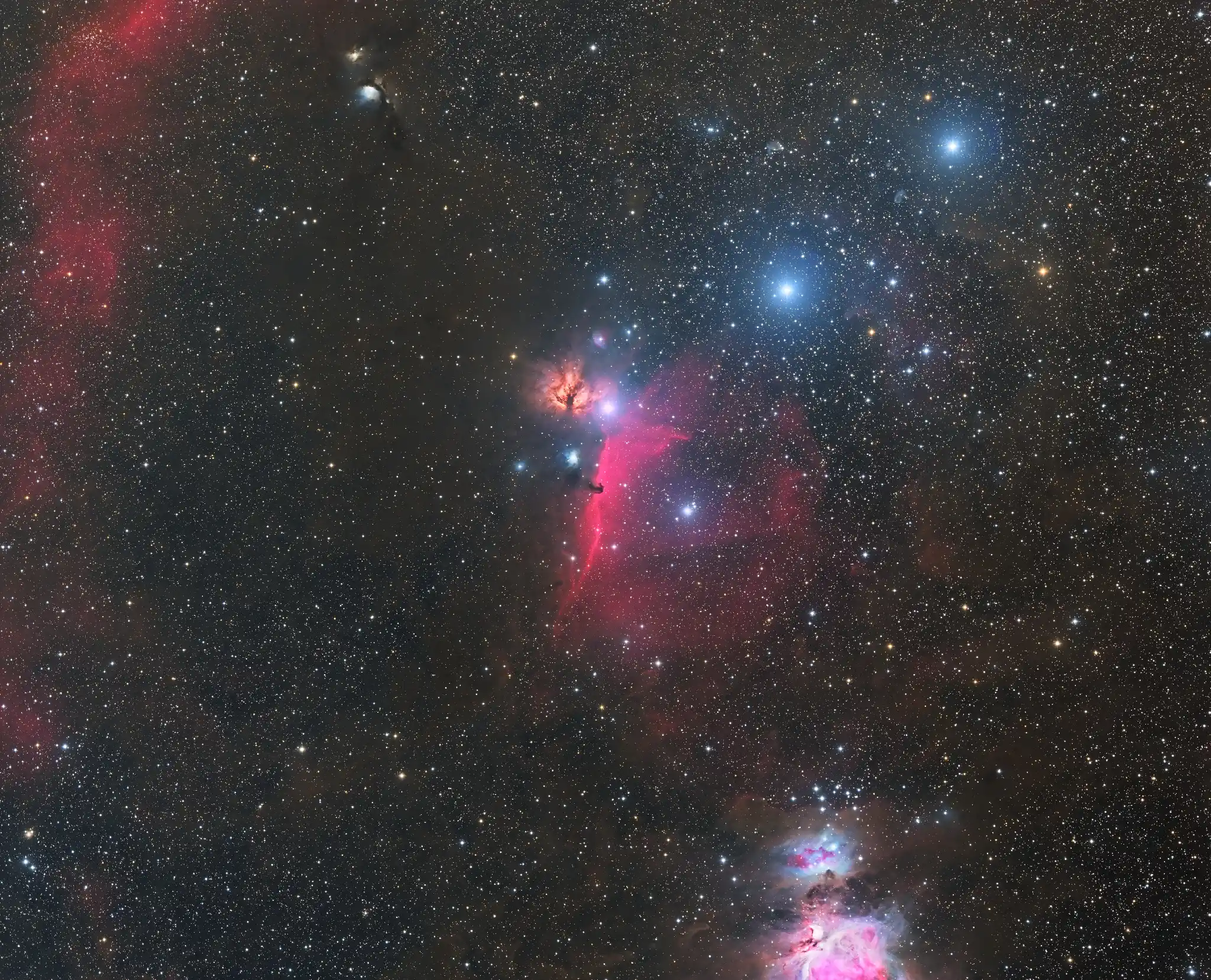
When we talk about late autumn nights, we have to talk about the constellation of Orion. As one of the most impressive and richest in deep-sky objects constellation in the sky, one can spend hours talking about its beauties. Stars, clusters, nebulae, creation and destruction, all of this is present in this patch of sky. Even with the naked eye, the central part of the constellation steals the show. Here we can find molecular clouds where stars are being born, hot clouds of gas, giant and supergiant stars or, not the least, dusty agglomerations that reflect the light of the newborn stars.
Orion’s belt is a seemingly random alignment of 3 magnificent stars – Alnitak, Alnilam and Mintaka – which are much bigger and brighter than our modest Sun. These O and B-type supergiants cast their blue light on the surrounding Orion OB1 molecular complex Alnitak is surrounded by nebulae, like the dark cloud Barnard 33 (Horsehead Nebula), the emission nebula NGC 2024 (Flame Nebula) and the smaller reflection nebulae NGC 2023 and IC 435.
South of the belt we find the very well-known Orion Nebula complex, which is made of several NGC objects, like the open cluster NGC 1981, the Running Man Nebula complex (NGC 1973, 1975, 1977), the emission nebula Messier 43 and the main actor in all this huge cloud, Orion’s Nebula (Messier 42). This part of the sky is visible with the naked eye, being the closest massive star formation region to the Sun (1344 light-years distant). The nebulae have been searched for protostars, protoplanetary disks and young stellar objects, and the search has been more than fruitful. Astronomers have observed stars in various stages of their formation, powerful jets of matter ejected in the gravitational collapse process and even the beginning of planetary formation.
Moving to the NW of the Orion’s Belt we find another of Messier’s objects – nr. 78 in his catalogue, sometimes named Casper Nebula due to the resemblance to the friendly ghost. This is also a combination of 3 NGC objects (2064, 2067, 2071), all part of the Orion B molecular cloud. Even though it’s smaller and not so fiery as the Orion’s Nebula, scientists have detected 45 T-Tauri stars and 17 Herbig-Haro objects, proving the star formation in this cloud is far from over.
To the West of the Belt, we can see a very small part of Barnard’s Loop (Sh2-276), a very elongated emission nebula that basically surrounds most of the central part of the Orion constellation. It is part of the same molecular complex as the Horsehead Nebula and Orion Nebula and apparently is being ionized by the stars in Messier 42. It has an impressive length of 360 light-years but it’s quite dim, so only long-exposure photographs will show it. It is thought to have originated in a supernova explosion about 2 million years ago, which may have also created several known runaway stars, including AE Aurigae, Mu Columbae and 53 Arietis, which are believed to have been part of a multiple star system in which one component exploded as a supernova. Apparently hidden in the Loop, the open cluster NGC 2112 is actually twice more distant and it’s also much older, having an estimated age of 2 billion years.
B33
1 credit
- Tipo di obiettivo............................................................................................................................Dark Nebula
- Fotocamera............................................................................................................................FLI ML16200
- Coordinate dell'obiettivo............................................................................................................................RA 85.24583 Dec -2.45833
- Emisfero............................................................................................................................Southern
- Posizione del telescopio............................................................................................................................Chile
- Evento transitorio............................................................................................................................No
- Osservato il............................................................................................................................09 Feb 2021 - 09 Feb 2021
Filtro | Exp. media (s) | Esposizione totale | Sottoframe |
|---|---|---|---|
| Luminance | 180 | 12m | 4 |
| Red | 180 | 12m | 4 |
| Green | 240 | 12m | 3 |
| Blue | 240 | 12m | 3 |
| Halpha | 60 | 3m | 3 |