02 Feb 2026
Large Magellanic Cloud (LMC) HII Regions
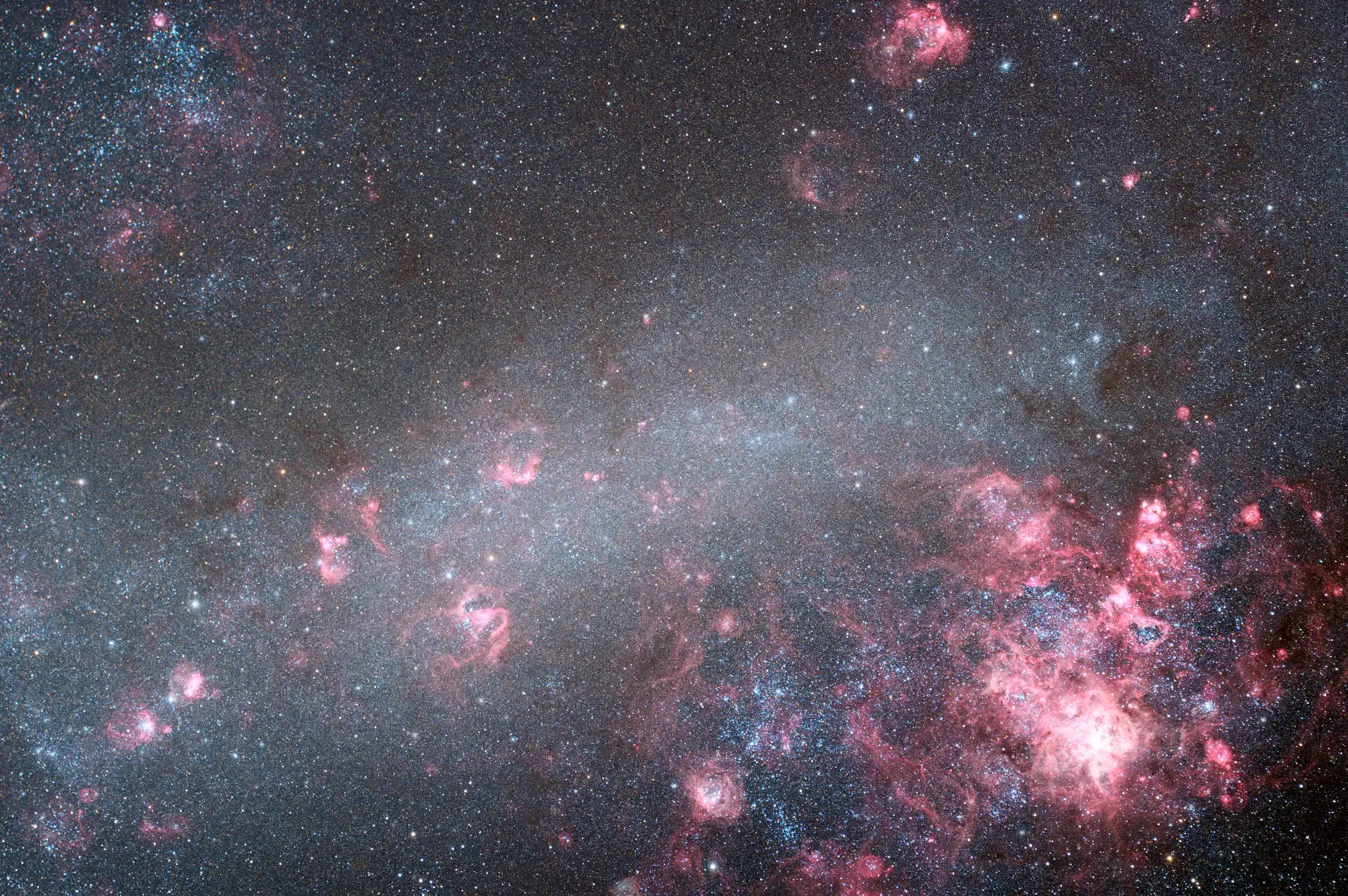
A closer view of the Large Magellanic Cloud (LMC). The LMC is a satellite galaxy of the Milky Way Galaxy. It is a dwarf irregular galaxy about 200 KLY distant. It is only visible in the southern hemisphere but can be seen naked eye on a dark night. It straddles the constellations Dorado and Mensa.
The galaxy contains vast clouds of hydrogen gas that slowly collapses to form new stars. The image shows these nebulous star forming regions glowing in red. The brown nebulous regions are dust clouds. The bright blue stars in the image are massive blue stars with short lifespans on the order of hundreds of thousands of years. The yellow stars are cooler stars like our sun and have a long lifespan on the order of ten billion years or more. (NASA.gov)
The large nebula in the lower right of the image is the Tarantula Nebula. It is an extremely luminous star burst region.
Image processed by Andrew Macica, original data from Telescope Live. Unlike the previous image, this image incorporated the H-alpha data that was captured.
Since the HII clouds of Hydrogen gas emit radiation in the H-alpha region, these clouds are much more prominent in this image compared to the previous image.
Imaging Details:
Observatory: Heaven's Mirror Observatory, Yass, Australia
Telescope: Takahashi FSQ-106ED
Aperture: 106 mm (4.17 inches), f/3.6
Focal Length: 382 mm (with 0.73x focal reducer)
Camera: QHY 600M Pro CMOS
Filters: LRGB, Ha
Total Exposure: 10 hours 0 minutes
Image Processing: PixInsight 1.8.9-3 Ripley (x64);
BlurXTerminator, NoiseXTerminator, StarXTerminator (RC Astro);
Python 3.9
Adobe Photoshop 12.5.1;
Adobe Lightroom Classic 14.1.1
Instruction on PixInsight from Adam Block Studios.
Large Magellanic Cloud
8 credit
- Tipo di obiettivo............................................................................................................................Galaxy
- Fotocamera............................................................................................................................QHY 600M
- Coordinate dell'obiettivo............................................................................................................................RA 80.8942 Dec -69.7561
- Emisfero............................................................................................................................Southern
- Posizione del telescopio............................................................................................................................Australia
- Evento transitorio............................................................................................................................No
- Osservato il............................................................................................................................02 Mar 2023 - 30 Sept 2024
Filtro | Exp. media (s) | Esposizione totale | Sottoframe |
|---|---|---|---|
| Luminance | 713 | 3h10m | 16 |
| Red | 563 | 2h30m | 16 |
| Green | 563 | 2h30m | 16 |
| Blue | 563 | 2h30m | 16 |
| Halpha | 600 | 2h30m | 15 |