02 Feb 2026
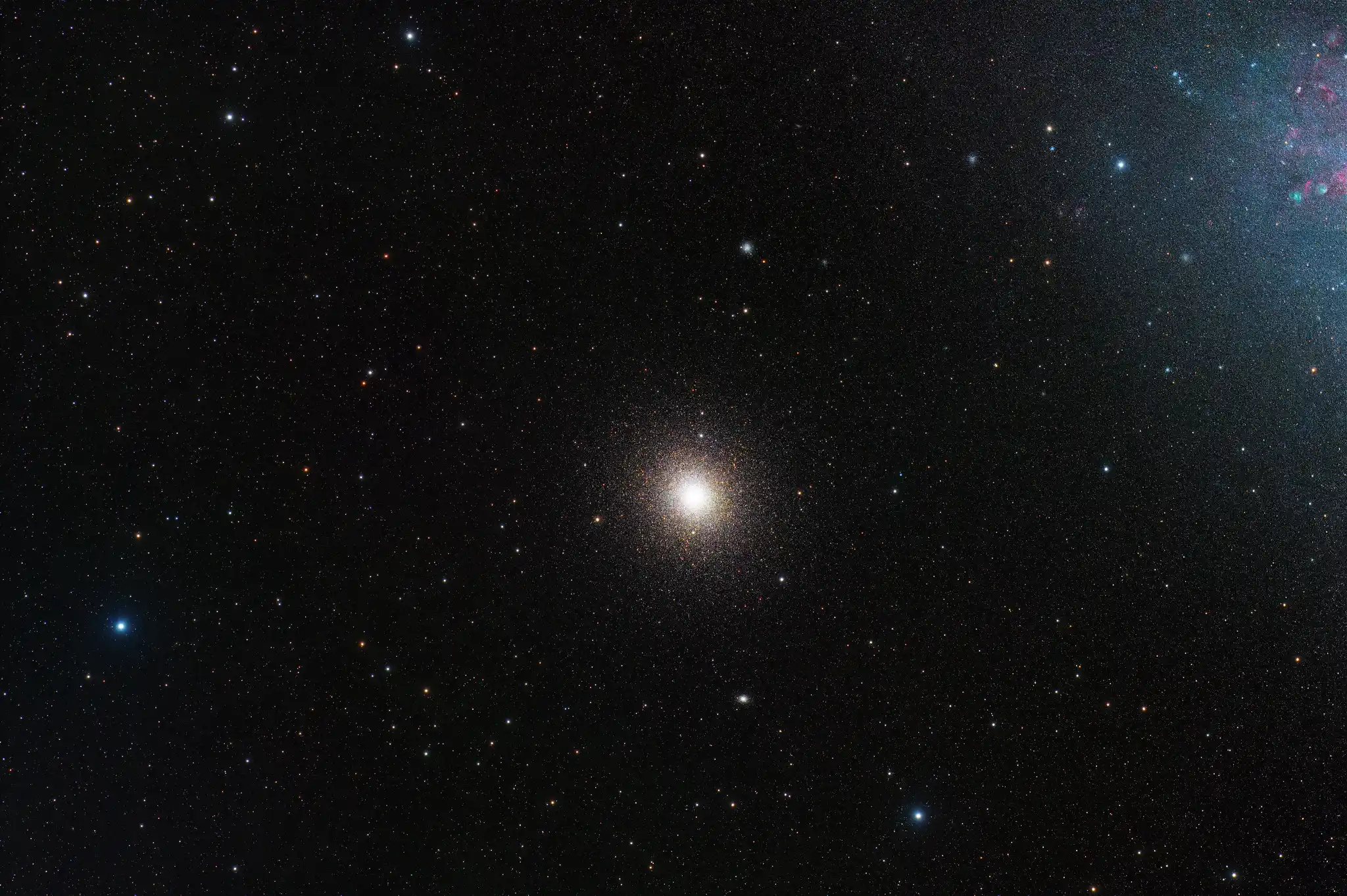
NGC 104, 47 Tucanae, Globular Cluster
NGC 104, also known as 47 Tucanae, is a globular cluster in the southern hemisphere near the Small Magellanic Cloud (SMC). It is the second brightest globular cluster in the sky. The brightest is Omega Centari, NGC 5139. 47 Tucanae is composed of several million stars and is 13,000 LY distant. (APOD)
A portion of the Small Magellanic Cloud (SMC) is in the upper right corner of the image.
The color of all of the stars in the image is enhanced but accurate. Star colors were calibrated using spectral data from the Gaia DR3/SP database. It is interesting to compare the colors of stars in the SMC compared to NGC 104.
Both the globular cluster and the SMC formed at about the same time as the Milky Way Galaxy. The much larger SMC still has many Hydrogen HII regions that is forming new stars. Many of the stars are hot blue stars with a short lifespan. The young hot blue stars and the red HII gas regions can be seen in the SMC in the upper right corner of the image.
On the other hand, the smaller globular cluster is composed of cooler red and yellow stars with a much longer lifespan. The hydrogen gas in the globular cluster was used up billions of years ago. The hot blue stars that existed in the cluster died out billions of years ago leaving only the cooler long living stars.
Image processed by Andrew Macica, original data from Telescope Live.
Imaging Details:
Observatory: Heaven's Mirror Observatory, Yass, Australia
Telescope: Takahashi FSQ-106ED
Aperture: 106 mm (4.17 inches), f/3.6
Focal Length: 382 mm (with 0.73x focal reducer)
Camera: QHY 600M Pro CMOS
Filters: LRGB
Total Exposure: 4 hours 12 minutes
Image Processing: PixInsight 1.8.9-3 Ripley (x64);
BlurXTerminator, NoiseXTerminator (RC Astro);
Adobe Photoshop 12.5.1;
Adobe Lightroom Classic 14.1.1
Instruction on PixInsight from Adam Block Studios.
NGC 104
3 credit
- Tipo di obiettivo............................................................................................................................Globular Cluster
- Fotocamera............................................................................................................................QHY 600M
- Coordinate dell'obiettivo............................................................................................................................RA 6.0223 Dec -72.0814
- Emisfero............................................................................................................................Southern
- Posizione del telescopio............................................................................................................................Australia
- Evento transitorio............................................................................................................................No
- Osservato il............................................................................................................................16 Aug 2023 - 16 Jun 2024
Filtro | Exp. media (s) | Esposizione totale | Sottoframe |
|---|---|---|---|
| Blue | 180 | 1h9m | 23 |
| Green | 180 | 1h9m | 23 |
| Red | 180 | 1h9m | 23 |
| Luminance | 180 | 1h9m | 23 |