03 Feb 2026
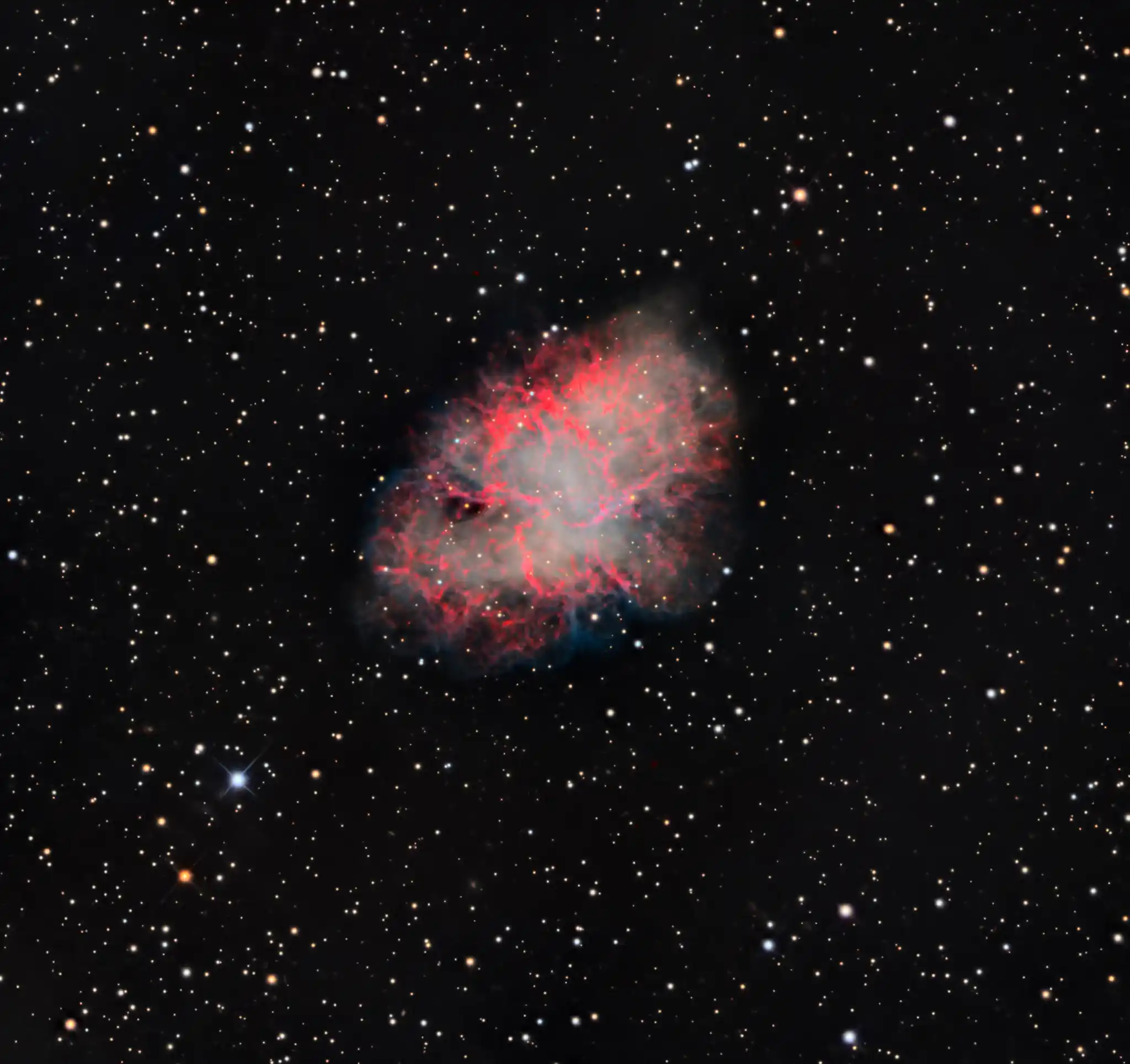
Messier 1, Supernova Remnant
Messier 1 is a supernova remnant in the constellation Taurus. (TheSky, Software Bisque)
In 1054, Chinese astronomers took notice of a “guest star” that was, for nearly a month, visible in the daytime sky. The “guest star” they observed was actually a supernova explosion, which gave rise to the Crab Nebula, a six-light-year-wide remnant of the violent event. (NASA)
Visible in the image and embedded at the center of the nebula is a rapidly spinning neutron star (the ultra-dense core of the exploded star. (NASA)
The red filaments are rapidly expanding hydrogen gas excited by the radiation from the neutron star. The white misty core is a combination of heavier elements such as oxygen and sulfur, mixed with hydrogen. These elements are also excited by the radiation from the neutron star giving a soft white glow.
Image processed by Andrew F. Macica, original data from Telescope Live.
Imaging Details:
Observatory: Oria, Spain
Telescope: Officina Stellare 700 RC
Aperture: 700 mm (27.5 inches), f/8
Focal Length: 5600 mm
Camera: FLI ProLine PL16803 CCD
Filters: LRGB
Total Exposure: 15 hours 16 min.
Image Processing:
PixInsight 1.8.9-3 Ripley (x64);
BlurXTerminator, NoiseXTerminator, StarXTerminator (RC Astro);
Adobe Photoshop 25.12.4;
Adobe Lightroom Classic 15.1.1
Instruction on PixInsight from Adam Block Studios.
M1
13 credit
- Tipo di obiettivo............................................................................................................................Supernova Remnant
- Fotocamera............................................................................................................................FLI PL16803
- Coordinate dell'obiettivo............................................................................................................................RA 83.6331 Dec 22.0145
- Emisfero............................................................................................................................Northern
- Posizione del telescopio............................................................................................................................Spain
- Evento transitorio............................................................................................................................No
- Osservato il............................................................................................................................24 Oct 2019 - 06 Dec 2021
Filtro | Exp. media (s) | Esposizione totale | Sottoframe |
|---|---|---|---|
| Green | 74 | 1h25m | 69 |
| Blue | 75 | 1h25m | 68 |
| Halpha | 364 | 6h52m | 68 |
| Red | 233 | 4h24m | 68 |
| Luminance | 62 | 1h10m | 68 |