05 Feb 2026
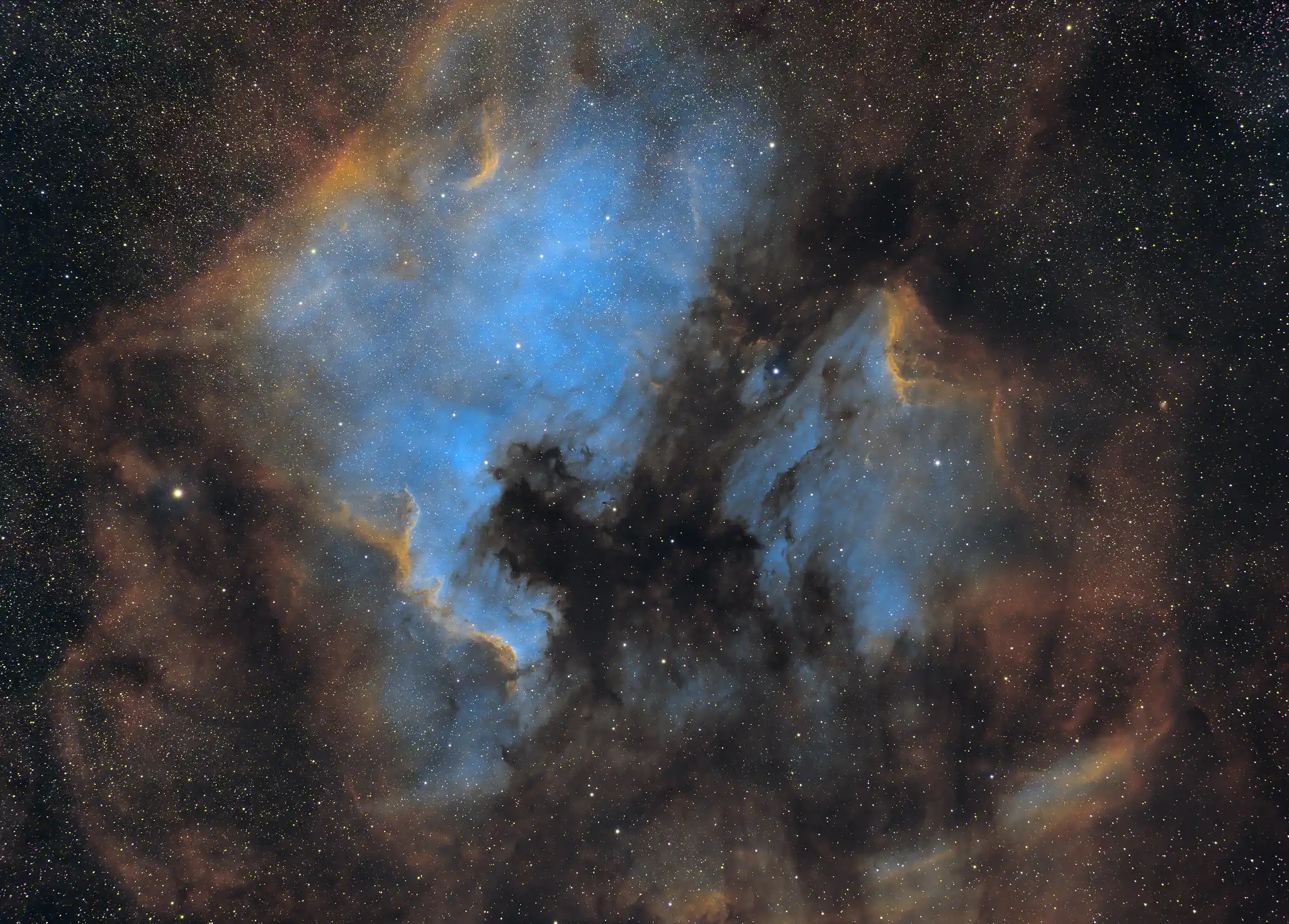
NGC 7000, The North American Nebula, Foraxx Palette
NGC 7000, the North American Nebula, is a stunning example of an emission nebula. The clouds of gas that make up the nebula are being ionized by a nearby star, causing the gas to glow as it emits energy. (NASA Science)
NGC 7000 is known as the North America Nebula due to its similarity in shape to the geographical outline of the North American continent.
This image is a narrowband image. Ionized gases in this nebula produce three prominent emissions: Hydrogen Alpha (656.3 nm), Sulfur II (672 nm) and Oxygen III (500.7 nm).
A formula is used to assign pixel values to RGB channels. The purpose is to more closely emulate the classic Hubble Palette. The specific palette I used is the Foraxx Palette.
(PixInsight Forum)
The color mapping, for this image, is as follows:
Red: (OIII^~OIII) * SII + ~(OIII^~OIII) * Ha
Green: ((OIII*Ha)^~(OIII*Ha))*Ha + ~((OIII*Ha)^~(OIII*Ha))*OIII
Blue: OIII
Bottom line, this mapping communicates the composition of different regions in the nebula. It does not represent the way the nebula appears to our eyes.
Image processed by Andrew Macica, original data from Telescope Live.
Imaging Details:
Observatory: IC Astronomy Observatory, Oria, Almería, Spain
Telescope: Takahashi FSQ-106EDX4
Aperture: 106 mm, w/ 0.73x focal reducer, f/3.6
Focal Length: 382 mm
Camera: QHY 600M Pro CMOS
Filters: SII, Ha, OIII (SHO)
Total Exposure: 9 hours 50 minutes
Image Processing:
PixInsight 1.8.9-3 Ripley (x64);
BlurXTerminator, NoiseXTerminator, StarXTerminator (RC Astro);
Python 3.9;
Adobe Photoshop 25.12.1;
Adobe Lightroom Classic 14.2
Instruction on PixInsight from Adam Block Studios.
NGC7000
7 credit
- Tipo di obiettivo............................................................................................................................Emission Nebula
- Fotocamera............................................................................................................................QHY 600M
- Coordinate dell'obiettivo............................................................................................................................RA 314.0721 Dec 44.0439
- Emisfero............................................................................................................................Northern
- Posizione del telescopio............................................................................................................................Spain
- Evento transitorio............................................................................................................................No
- Osservato il............................................................................................................................02 May 2023 - 01 Nov 2023
Filtro | Exp. media (s) | Esposizione totale | Sottoframe |
|---|---|---|---|
| Halpha | 323 | 3h35m | 40 |
| SII | 300 | 3h15m | 39 |
| OIII | 277 | 3h | 39 |