05 Feb 2026
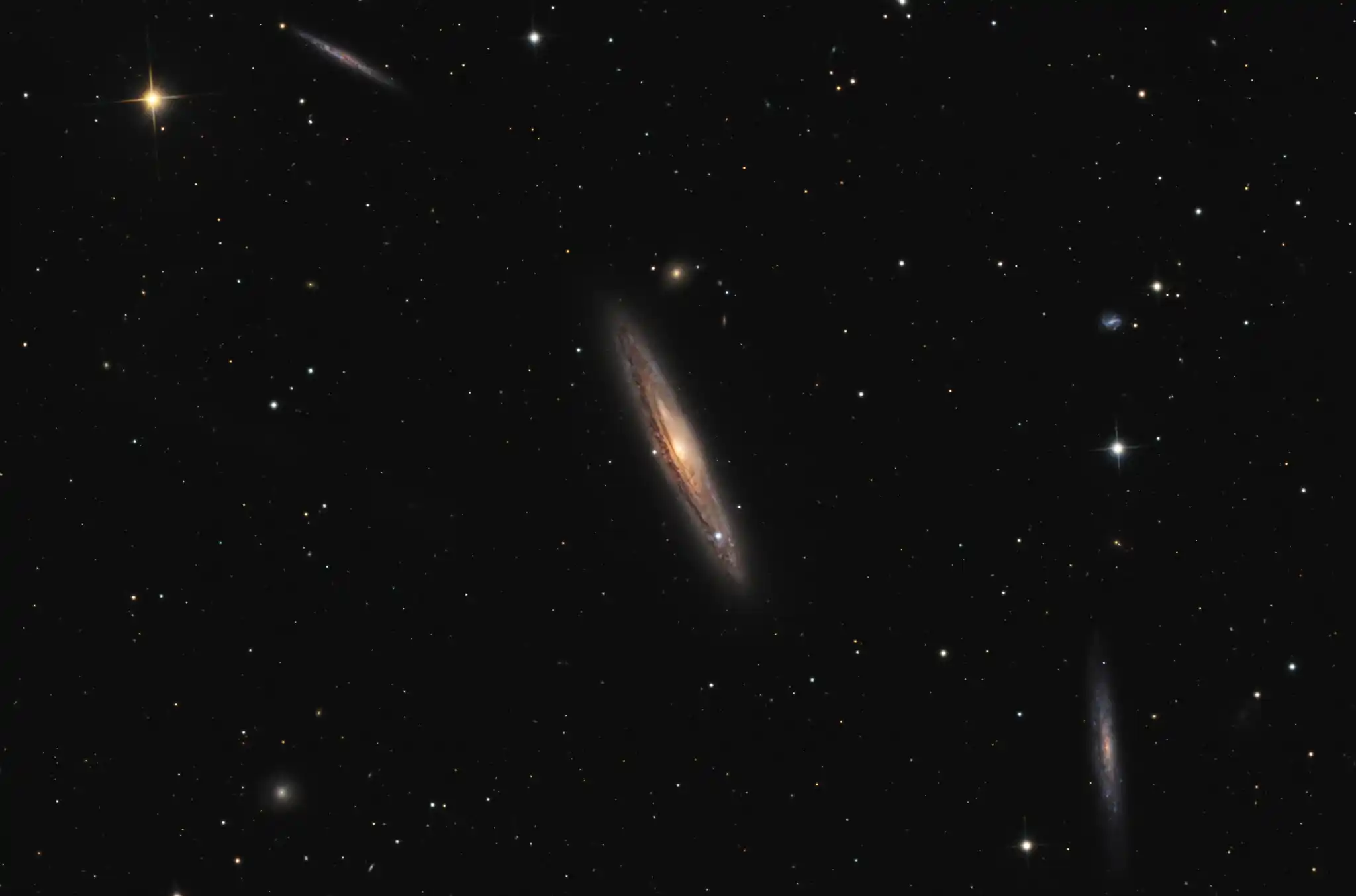
NGC 4216 - Spiral Galaxy with Supernova 2024gy in Virgo
NGC 4216 is a striking intermediate barred spiral galaxy seen nearly edge-on in the rich Virgo Cluster at a distance of roughly ~55 million light-years. With its elongated dust lanes silhouetted against a bright, metal-rich stellar disk, NGC 4216 is one of the largest and most luminous spirals in Virgo. Its optical profile reveals a dense central bulge flanked by subtle pillar-like structures and filamentary features thought to arise from past interactions with the intracluster medium and disrupted dwarf companions. Unlike many grand design spirals, this galaxy shows a relatively low surface density of neutral hydrogen and subdued star formation, characteristics that classify it as somewhat anemic for its class. In its halo resides an unusually rich system of globular clusters and tenuous stellar streams, markers of its cannibalistic accretion history.
In early January 2024 a luminous new point of light appeared embedded along the disk of NGC 4216: Supernova 2024gy, a Type Ia thermonuclear explosion discovered by prolific amateur supernova hunter Kōichi Itagaki on January 4. This class of supernova arises from the runaway carbon fusion in a white dwarf that has accreted material from a binary companion, producing a bright, blue-white flash that for a time outshines its entire host galaxy. In this post-event integration, the supernova’s compact, stellar-like glow stands out against the smooth background of NGC 4216’s disk, offering a snapshot of a rare transient in a massive Virgo-Cluster spiral. As is typical for Type Ia events, the explosion provides a standardized luminosity beacon useful for extragalactic distance studies, while its location within the nearly edge-on disk presents a compelling contrast between the serene steady-state galaxy and a fleeting, energetic endpoint of stellar evolution.
This image is based on 2 hours and 20 minutes of LRGB data from Telescope Live’s CHI-1-CCD and CMOS systems.
NGC4216 with SN 2024gy
1 credit
- Tipo di obiettivo............................................................................................................................Galaxy
- Fotocamera............................................................................................................................QHY 600M
- Coordinate dell'obiettivo............................................................................................................................RA 183.97691 Dec 13.1494
- Emisfero............................................................................................................................Southern
- Posizione del telescopio............................................................................................................................Chile
- Evento transitorio............................................................................................................................No
- Osservato il............................................................................................................................20 Jan 2024 - 20 Jan 2024
Filtro | Exp. media (s) | Esposizione totale | Sottoframe |
|---|---|---|---|
| Luminance | 300 | 15m | 3 |
| Red | 300 | 15m | 3 |
| Green | 300 | 15m | 3 |
| Blue | 300 | 15m | 3 |