09 Feb 2026
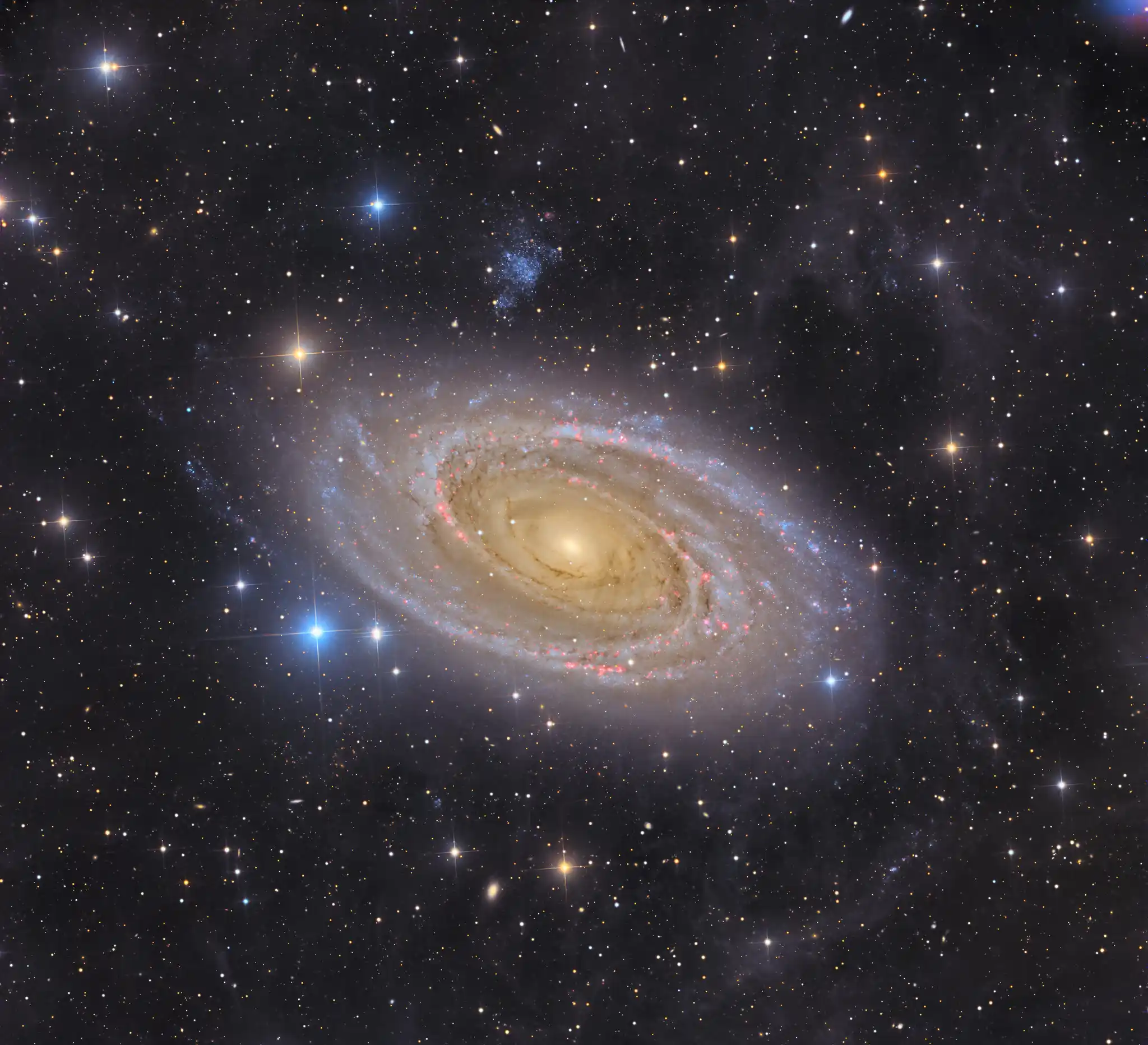
Messier 81
Messier 81 is one of the brightest galaxies in the night sky. It is located 11.6 million light-years from Earth in the constellation Ursa Major and has an apparent magnitude of 6.9. (NASA Science)
The galaxy’s central bulge contains much older, redder stars. It is significantly larger than the Milky Way’s bulge. A black hole of 70 million solar masses resides at the center of M81 and is about 15 times the mass of the Milky Way’s central black hole. Previous Hubble research showed that the size of the black hole in a galaxy’s nucleus is proportional to the mass of the galaxy’s bulge. (NASA Science)
Seen in the background extending out from M81 is Intergalactic Cirrus or dust clouds.
Also seen above and slightly to the left of M81 is the dwarf irregular galaxy PGC 28757 (Holmberg IX), a satellite galaxy of M81. (NASA Science)
Image processed by Andrew F. Macica, original data from Telescope Live.
Imaging Details:
Observatory: Bernard Miller, USA
Telescope: Planewave CDK17 on a Paramount ME Mount
Aperture: 430 mm (17 inches), f/6.8
Focal Length: 2940 mm
Camera: FLI Proline PL16803 CCD
Filters: Ha, LRGB
Total Exposure: 30 hours 0 min.
Image Processing: PixInsight 1.9.3 Lockhart (x64);
BlurXTerminator, NoiseXTerminator, StarXTerminator (RC Astro);
Adobe Photoshop 25.12.4;
Adobe Lightroom Classic 14.5
Instruction on PixInsight from Adam Block Studios.
M81
20 credit
- Tipo di obiettivo............................................................................................................................Galaxy
- Fotocamera............................................................................................................................FLI Proline PL16803
- Coordinate dell'obiettivo............................................................................................................................RA 148.8883 Dec 69.0653
- Emisfero............................................................................................................................Northern
- Posizione del telescopio............................................................................................................................United States of America
- Evento transitorio............................................................................................................................No
- Osservato il............................................................................................................................02 Feb 2022 - 08 Mar 2022
Filtro | Exp. media (s) | Esposizione totale | Sottoframe |
|---|---|---|---|
| Luminance | 1705 | 9h | 19 |
| Red | 758 | 4h | 19 |
| Green | 758 | 4h | 19 |
| Blue | 800 | 4h | 18 |
| Halpha | 1800 | 9h | 18 |