19 Feb 2026
NGC 4151
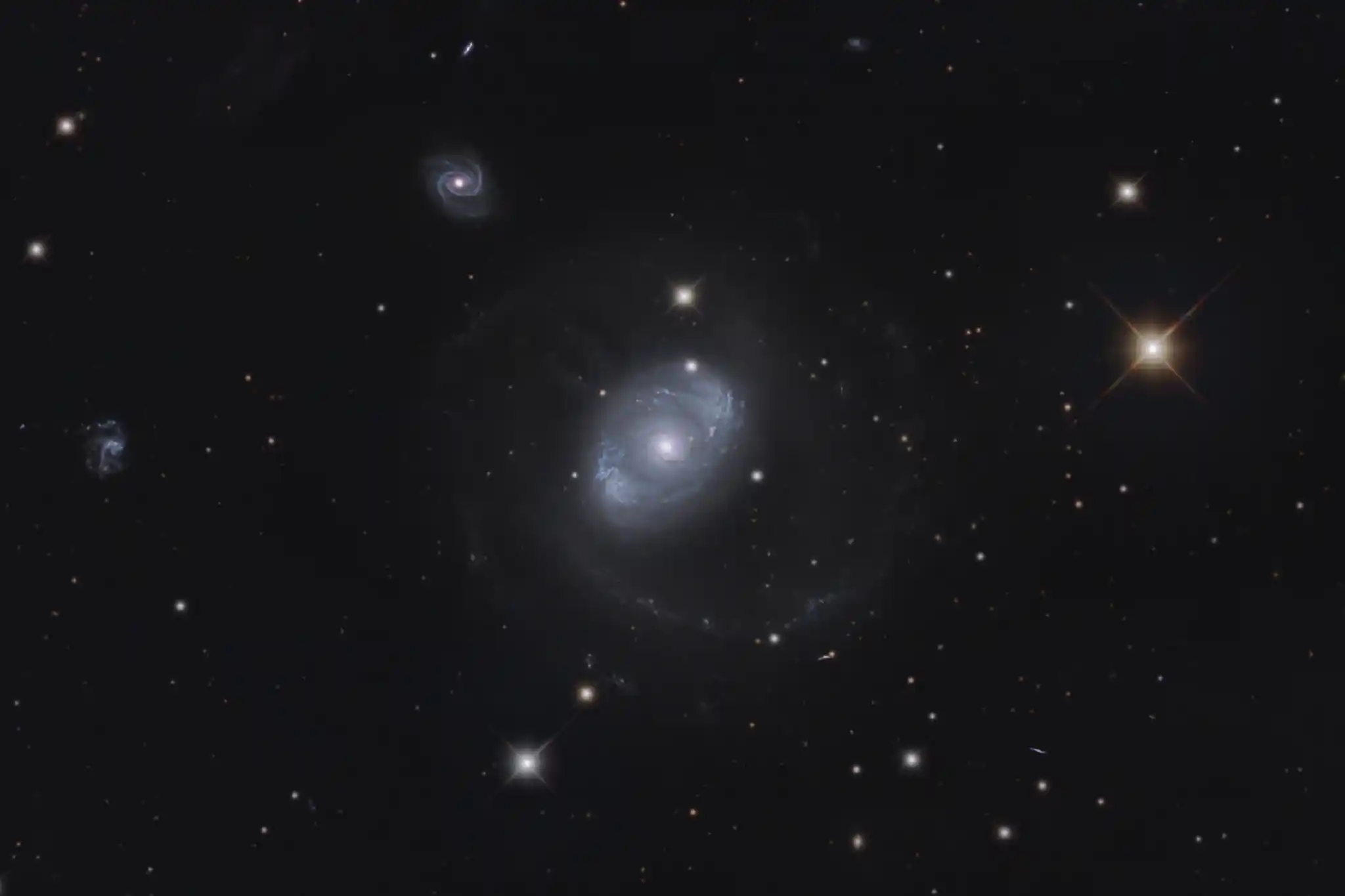
NGC 4151 is an intriguing spiral galaxy, discovered by William Herschel in 1787. Modern images reveal an intense central nucleus surrounded by an oval ring of stars, dust, and gas. Red spots in the spiral arms represent a series of emission nebulae, while blue areas indicate clusters of newly formed stars. Study of its spiral structure indicates the presence of a central bar, leading astronomers to classify it as a SAB spiral galaxy, intermediate between barred and unbarred spiral galaxies.
American astronomer Carl Seyfert first discovered that the center of NGC 4151 is unusual. His groundbreaking research led to the naming of this and similar galaxies as Seyfert galaxies. Seyfert galaxies contain actively growing supermassive black holes hidden at their cores. In a sense, they represent the missing link between quasars and relatively dormant galactic black holes like our Milky Way. About 52 million light-years away, NGC 4151 is one of the closest galaxies with an active galactic nucleus, allowing for closer study. In 1970, the Uhuru X-ray Observatory satellite detected X-ray emission from NGC 4151, providing evidence of a central black hole. Four decades later, the Chandra X-ray Observatory obtained data suggesting that this emission is likely caused by an outburst powered by the supermassive black hole as material swirls around it in an accretion disk.
The combination of visible, radio, and X-ray images of the galaxy's core gives NGC 4151 a supernatural appearance, earning it the nickname "The Eye of Sauron" (from The Lord of the Rings). (Text info Astronomy January 2024.)
NGC 4151
3 credit
- Tipo di obiettivo............................................................................................................................Galaxy
- Fotocamera............................................................................................................................QHY 600M
- Coordinate dell'obiettivo............................................................................................................................RA 182.6357 Dec 39.4059
- Emisfero............................................................................................................................Northern
- Posizione del telescopio............................................................................................................................Spain
- Evento transitorio............................................................................................................................No
- Osservato il............................................................................................................................23 Apr 2023 - 25 Apr 2023
Filtro | Exp. media (s) | Esposizione totale | Sottoframe |
|---|---|---|---|
| Blue | 120 | 1h | 30 |
| Green | 120 | 1h | 30 |
| Red | 120 | 1h | 30 |
| Luminance | 120 | 1h | 30 |