02 Mar 2026
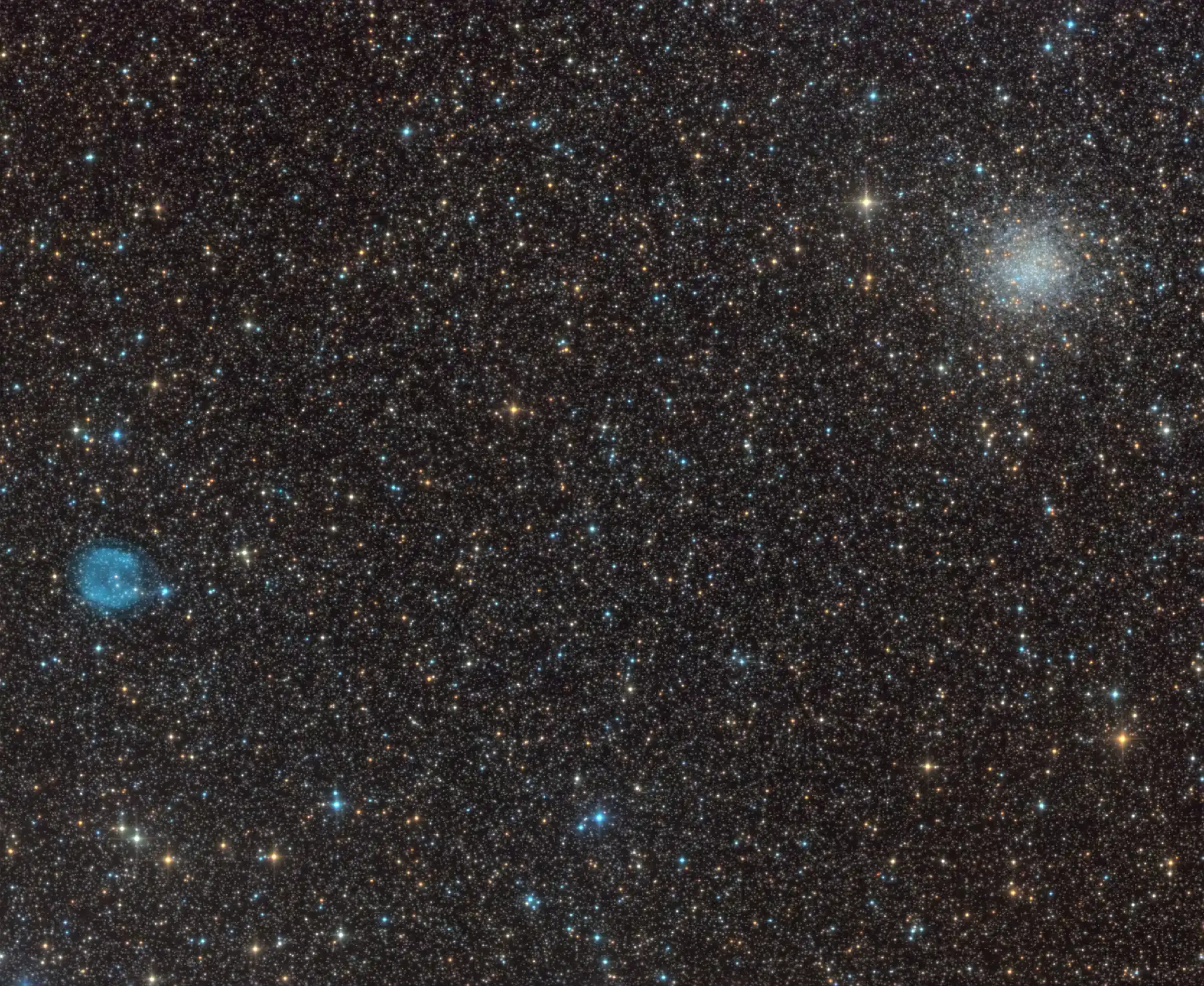
IC 1295 and NGC 6712
IC 1295 is a delicate and relatively faint planetary nebula located in the constellation Scutum. Though not as famous as brighter nebulae like Messier 57 or Messier 27, IC 1295 is a fascinating object that offers insight into the final stages of stellar evolution. The distance to the nebula is estimated at 4.500 light-years and its apparent magnitude is +12,7. IC 1295 was discovered in 1867 by Truman Safford.
Morphologically, IC 1295 consists of a faint, elliptical outer shell, an internal delicate filamentary structure and the hot, white dwarf located in the middle of the nebula and which is the source of the expanding gas cloud. The nebula’s blueish glow is due to the abundance of triple-ionized oxygen (OIII). The asymmetries in the nebular shell suggests some important mass loss occurred during the star’s final stages.
Not far from IC 1295, a much more distant object can be seen – the globular cluster NGC 6712 - which sits 26.400 light-years away. This object was discovered by Le Gentil in 1749 while observing the galactic star clouds in the Aquila region. Because of the high star density in the galactic plane and the fuzzy appearance of the cluster, he considered it a nebula. It wasn’t until 1830 that the stellar structure was observed by William Herschel. NGC 6712 appears to be 10-12 billion years old and has gone through several mass loss episodes, caused by passes through the galactic disk. Inside NGC 6712 there is a very curious object called PS J1853-0842A, consisting of a rapidly rotating pulsar accompanied by a low-mass brown dwarf. The intense radiation of the pulsar contributes to the evaporation of the companion, which has an estimated mass of 0,02 Suns. Although pulsars rotate more slowly with age, PSR J1853−0842A is accelerating, which would not be possible without it being within a globular cluster.
IC 1295
4 credit
- Tipo di obiettivo............................................................................................................................Planetary Nebula
- Fotocamera............................................................................................................................FLI ProLine PL9000
- Coordinate dell'obiettivo............................................................................................................................RA 283.4625 Dec -8.7897
- Emisfero............................................................................................................................Southern
- Posizione del telescopio............................................................................................................................Chile
- Evento transitorio............................................................................................................................No
- Osservato il............................................................................................................................11 May 2022 - 25 Aug 2022
Filtro | Exp. media (s) | Esposizione totale | Sottoframe |
|---|---|---|---|
| Green | 300 | 1h35m | 19 |
| Blue | 300 | 1h35m | 19 |
| Red | 300 | 1h35m | 19 |
| Luminance | 300 | 1h35m | 19 |