13 Apr 2026
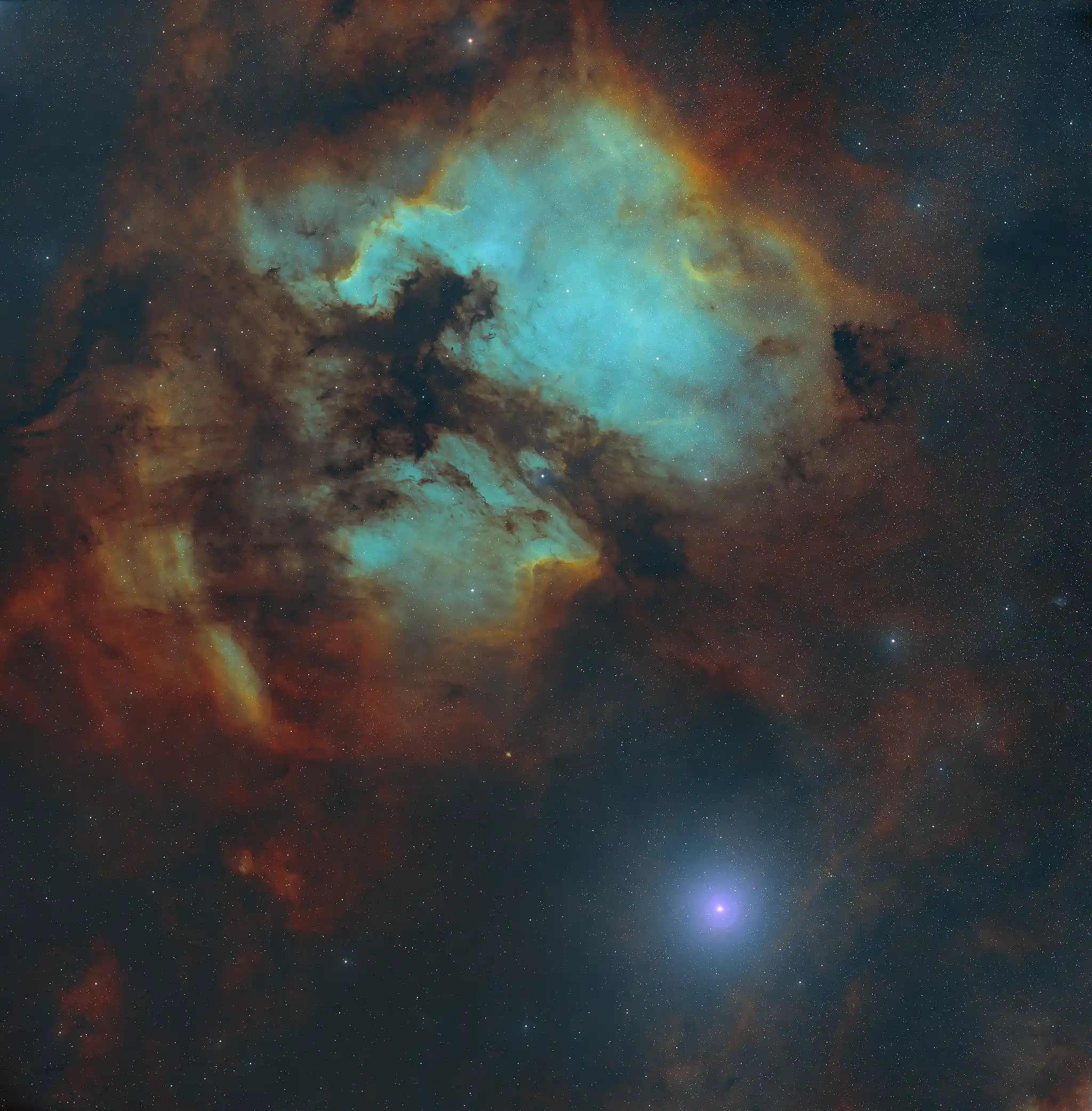
A Continent of Gas Floating in Cygnus
**A Continent of Gas Floating in Cygnus**
The North America Nebula, NGC 7000, is one of those objects that makes you think the universe has a certain sense of humor. Its silhouette reproduces the outline of the American continent with almost absurd accuracy — Gulf of Mexico included. It's not a forced metaphor or something you have to squint to see: it's just there, clearly, once you know where to look.
It lies in the constellation Cygnus, about 1,600 light-years from Earth, and it's a close neighbor of the Pelican Nebula, with which it shares both a gas cloud and an energy source. What separates them is a band of dark dust that blocks visible light and, following the logic of the map, goes by the name the Gulf of Mexico. The star responsible for lighting all of this up is most likely 2 Cygni, though for years there was genuine debate about which star was actually doing the job.
What makes NGC 7000 special isn't just its shape. Inside, there are active star-forming regions, especially in the area known as the Wall — a dense, bright zone where gas accumulates and collapses. It's not as dramatic as the Pillars of Creation, but the processes happening in there are essentially the same: gravity slowly winning its battle against chaos.
To observe it you need truly dark skies. With binoculars and good conditions you can actually make out its shape, which isn't something you can say about most nebulae of this kind. Through a telescope it gets even better, though paradoxically, large instruments sometimes cover too wide a field and ruin the effect. It's an object that rewards short focal length optics.
In photography it really comes alive. It responds beautifully to hydrogen-alpha filters, and in narrowband it reveals a rich internal structure — filaments, gas columns, and well-defined ionization regions. It's one of the most photographed objects in the northern sky, and for good reason.
It sits right next to Deneb, which makes it an easy reference point on summer nights. If you've ever looked at the Milky Way from a dark place and noticed that particularly dense, glowing patch in Cygnus — there's a good chance NGC 7000 was right there in front of you the whole time, and you just didn't know it.
NGC7000
7 credit
- Tipo di obiettivo............................................................................................................................Emission Nebula
- Fotocamera............................................................................................................................QHY 600M
- Coordinate dell'obiettivo............................................................................................................................RA 314.0721 Dec 44.0439
- Emisfero............................................................................................................................Northern
- Posizione del telescopio............................................................................................................................Spain
- Evento transitorio............................................................................................................................No
- Osservato il............................................................................................................................02 May 2023 - 01 Nov 2023
Filtro | Exp. media (s) | Esposizione totale | Sottoframe |
|---|---|---|---|
| Halpha | 323 | 3h35m | 40 |
| SII | 300 | 3h15m | 39 |
| OIII | 277 | 3h | 39 |