27 Jun 2026
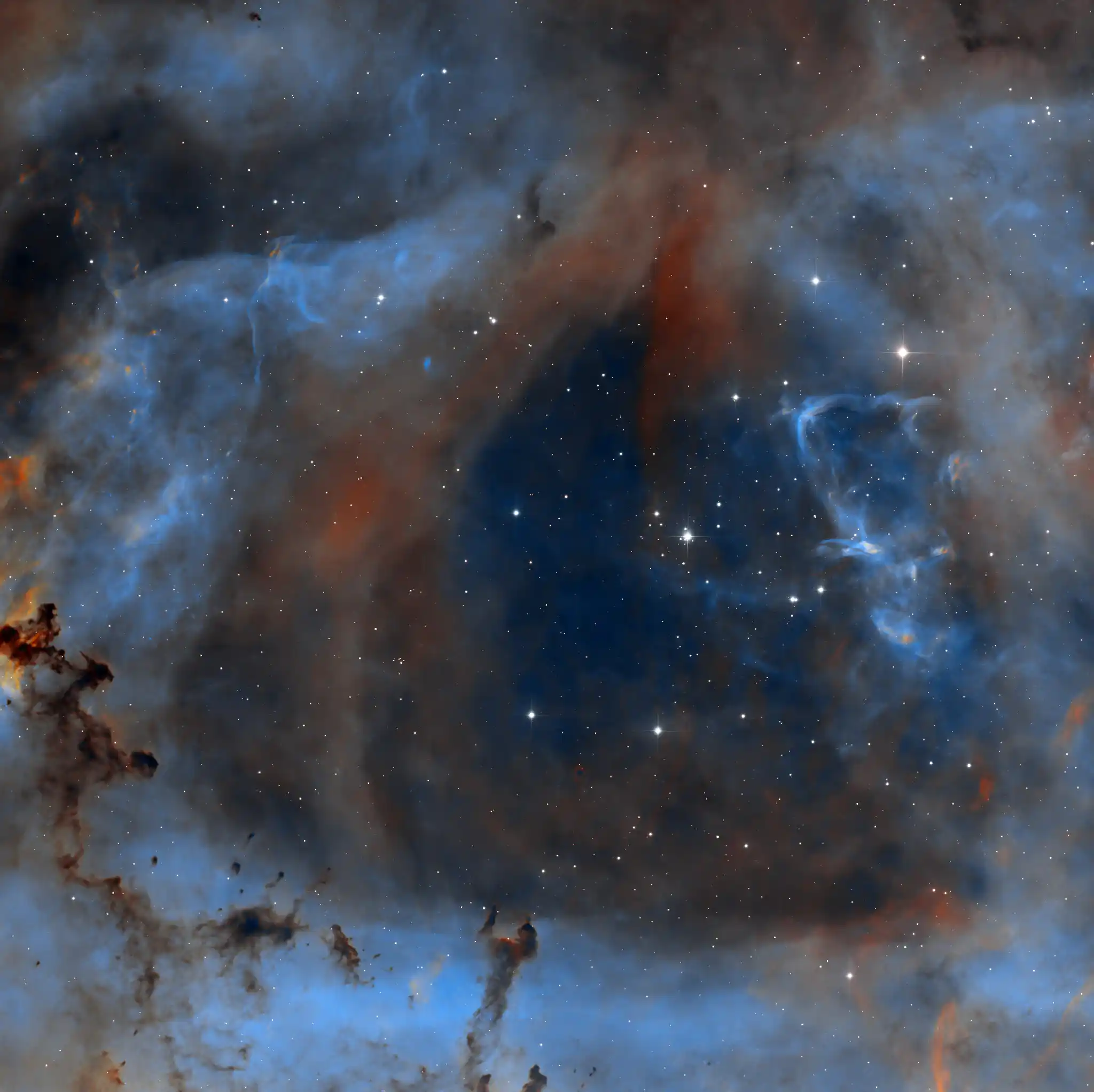
The Core Region of NGC 2244
NGC 2244 is an open cluster in the Rosette Nebula (NGC 2237), located in the constellation Monoceros. The hot O type stars in the cluster create a strong solar wind pushing out on the Rosette Nebula, giving the Rosette Nebula its characteristic doughnut shape. This image compared to the previous images is a zoomed perspective of the central region with a focus on the open cluster.
The Rosette Nebula, NGC 2237, is an emission nebula composed of hydrogen. Radiation from the hot O type stars excites the hydrogen gas causing it to glow.
This image is a narrowband image. Ionized gases in this nebula produce three prominent emissions: Hydrogen Alpha (656.3 nm), Sulfur II (672 nm) and Oxygen III (500.7 nm). I used the Seti Astro Foraxx Palette to map these emissions to RGB image channels. The mapping is as follows:
Red: Sulfur II (672 nm)
Green: Hydrogen Alpha (656.3 nm)
Blue: Oxygen III (500.7 nm)
Bottom line, this mapping communicates the composition of different regions in the nebula. It does not represent the way the nebula appears to our eyes.
Image processed by Andrew Macica, original data from Telescope Live.
Imaging Details:
Observatory: Rio Hurtado Valley, Chile
Telescope: Planewave CDK24
Aperture: 610 mm (24 inches), f/6.5
Focal Length: 3962 mm
Camera: FLI PL 9000 CCD
Filters: SII, H-alpha, OIII
Total Exposure: 6 hours 50 min.
Image Processing:
PixInsight 1.9.3 Lockhart (x64);
BlurXTerminator, NoiseXTerminator, StarXTerminator (RC Astro);
Adobe Photoshop 25.12.4;
Adobe Lightroom Classic 15.4.1
Instruction on PixInsight from Adam Block Studios.
Caldwell 49
5 credit
- Tipo di obiettivo............................................................................................................................Emission Nebula
- Fotocamera............................................................................................................................FLI ProLine PL9000
- Coordinate dell'obiettivo............................................................................................................................RA 97.9167 Dec 4.95
- Emisfero............................................................................................................................Southern
- Posizione del telescopio............................................................................................................................Chile
- Evento transitorio............................................................................................................................No
- Osservato il............................................................................................................................21 Jan 2020 - 06 Dec 2022
Filtro | Exp. media (s) | Esposizione totale | Sottoframe |
|---|---|---|---|
| Halpha | 300 | 2h20m | 28 |
| OIII | 300 | 2h15m | 27 |
| SII | 300 | 2h15m | 27 |