16 Jun 2024
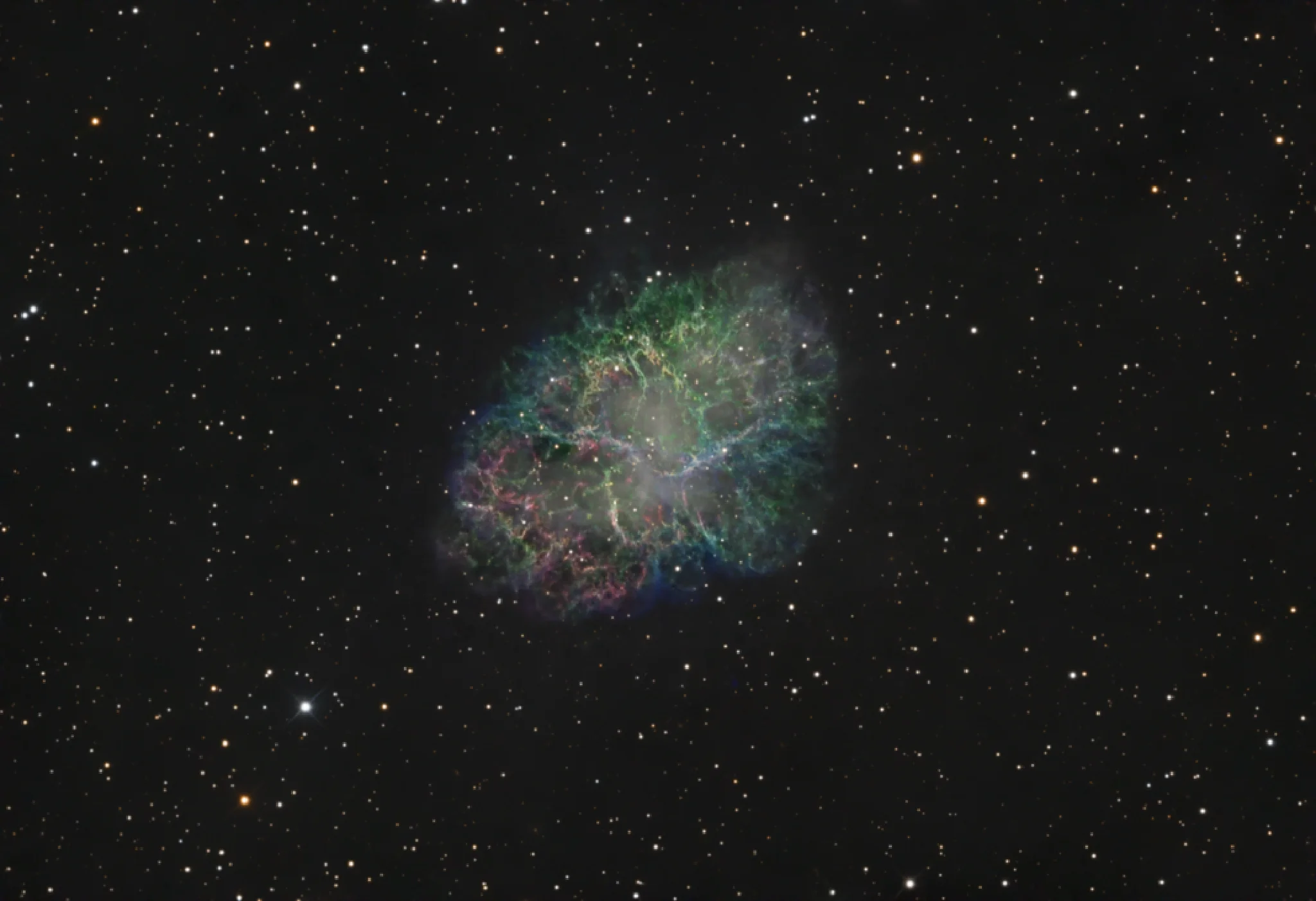
M1 Crab Nebula
Since its appearance in the sky as a Supernova nearly a thousand years ago the debris cloud created by particles being flung from the pulsar in its centre now extends to about 11 light years. Images taken over a relatively short period of time show just how fast expansion is occurring. This rapid expansion can best be seen in a short time lapse video created by Adam Block.
The image posted here was created using data from 3 scopes.
RGB data from CHI-1-CMOS has been used for the stars and the best 50 percent of those Red subs (27 minutes) for the Luminance.
The narrowband SHO data is a combination of SPA-2-CCD 120s subs and CHI-1-CCD 300s subs, giving approximately 2 1/2 hours integration time for each channel.
Finally a really interesting (yawn) fact. From the time the first narrowband subs in the posted image were captured until the last, the nebula probably increased in size by 8 light days!
M1
4 credit
- Tipo di obiettivo............................................................................................................................Supernova Remnant
- Fotocamera............................................................................................................................FLI ProLine PL9000
- Coordinate dell'obiettivo............................................................................................................................RA 83.6331 Dec 22.0145
- Emisfero............................................................................................................................Southern
- Posizione del telescopio............................................................................................................................Chile
- Evento transitorio............................................................................................................................No
- Osservato il............................................................................................................................28 Sept 2019 - 14 Dec 2022
Filtro | Exp. media (s) | Esposizione totale | Sottoframe |
|---|---|---|---|
| Luminance | 57 | 22m | 23 |
| Green | 42 | 16m | 23 |
| Red | 44 | 16m | 22 |
| Blue | 44 | 16m | 22 |
| Halpha | 573 | 3h30m | 22 |