21 Jul 2023
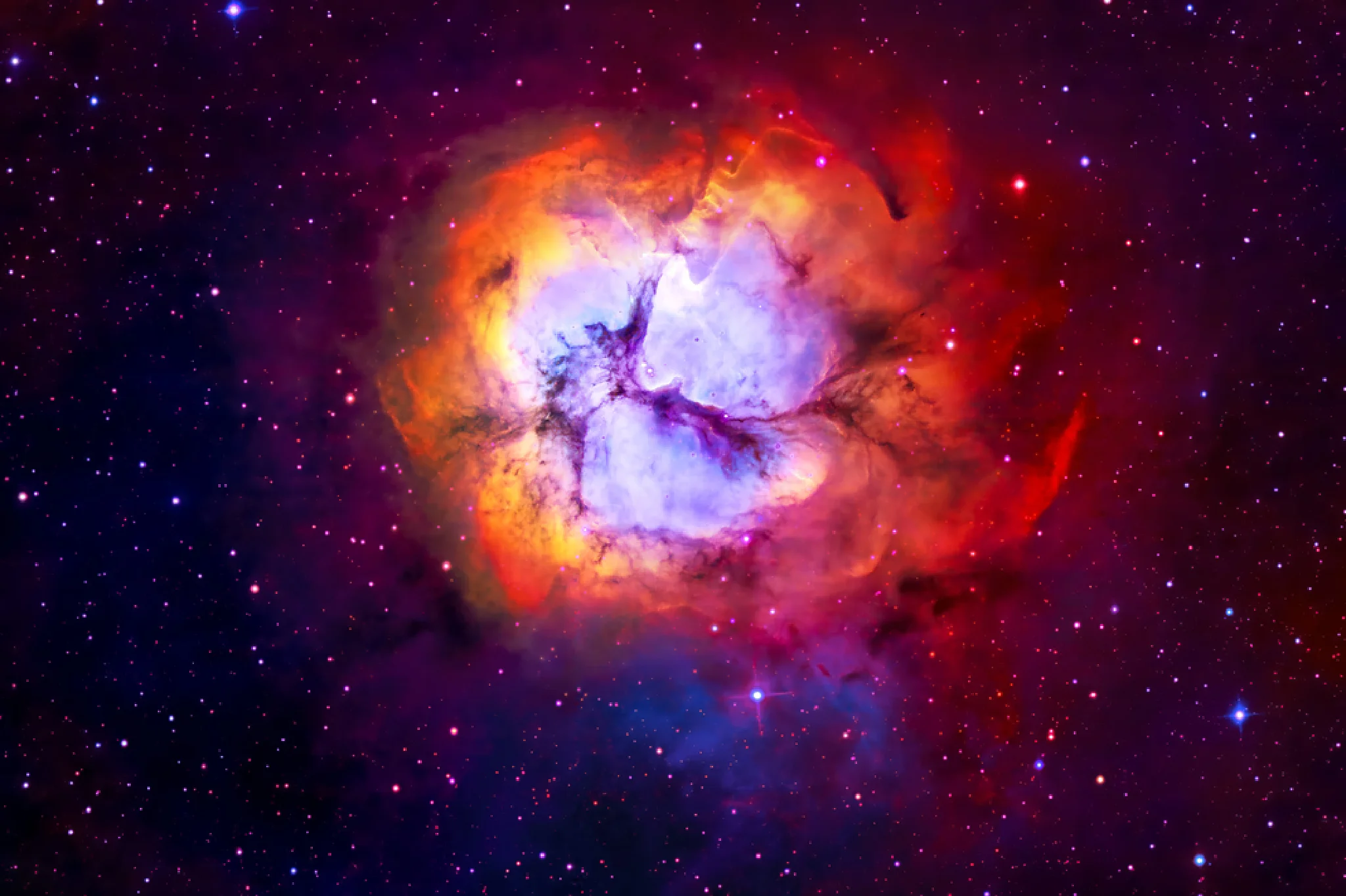
NGC 6514 / M20 - Trifid Nebula, 3rd (and last) take, more classic look
This is my third (and last) take on the M20, giving it the more classic, 'fireball in flight' look :) of the Trifid Nebula. All vertical and horizontal corrections are in place, and the outer edges which weren't aligned were cropped out. Colors have been enhanced, and the core is still smooth.
It's only as much as we can do with a single observation where the SNR is a bit lower compared to a full bundle, which I hope we'll get later in the year on TL.
I've totally enjoyed working on the M20, in all three different approaches I've taken since last night. By the time I finish writing this, it might be full 24h since I started aligning/merging the FITs in PixInsight, with few different palette output options, which I've processed and given final touches to today.
The Trifid Nebula (catalogued as Messier 20 or M20 and as NGC 6514) is an H II region in the north-west of Sagittarius in a star-forming region in the Milky Way's Scutum-Centaurus Arm. It was discovered by Charles Messier on June 5, 1764. Its name means 'three-lobe'. The object is an unusual combination of an open cluster of stars, an emission nebula (the relatively dense, reddish-pink portion), a reflection nebula (the mainly NNE blue portion), and a dark nebula (the apparent 'gaps' in the former that cause the trifurcated appearance, also designated Barnard 85) [Wiki]
M20
3 credit
- Tipo di obiettivo............................................................................................................................Emission Nebula
- Fotocamera............................................................................................................................QHY 600M
- Coordinate dell'obiettivo............................................................................................................................RA 270.6038 Dec -23.0018
- Emisfero............................................................................................................................Southern
- Posizione del telescopio............................................................................................................................Chile
- Evento transitorio............................................................................................................................No
- Osservato il............................................................................................................................16 Jun 2023 - 25 Oct 2023
Filtro | Exp. media (s) | Esposizione totale | Sottoframe |
|---|---|---|---|
| Halpha | 1000 | 2h30m | 9 |
| Blue | 200 | 30m | 9 |
| Luminance | 100 | 15m | 9 |
| Red | 100 | 15m | 9 |
| Green | 100 | 15m | 9 |