18 May 2024
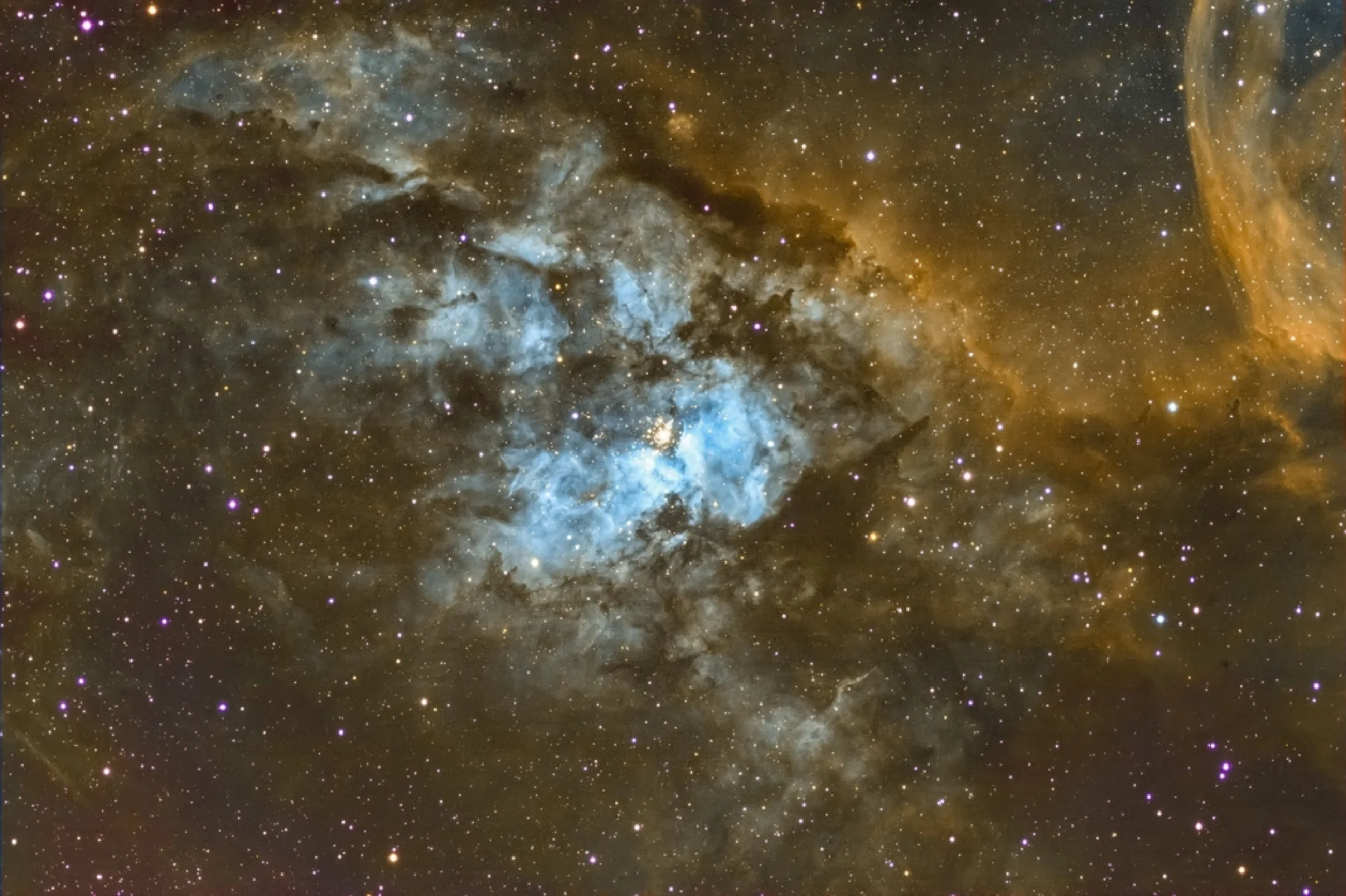
NGC 3603
NGC 3603 is a large H II region in the constellation Carina.
It is located to the west of the great Carina Nebula, near the westernmost edge of the bright stretch of the Milky Way that characterizes this part of the sky, the Arco della Carina; it is part of the Sagittarius Arm and can be photographed with relative ease through a telescope. Being an object with a strongly southern declination, its observation is precluded to most observers in the northern hemisphere, while it is well observable from the regions of the southern hemisphere.
The nebula is visible to the telescope as a small nebulosity with a yellowish color, due to the effect of stellar absorption. In the 1960s, it was discovered to be a high-temperature source of radio waves; When the starburst phenomenon became known, this process was assimilated to the nebula: in fact, it is a region where star formation is vigorous. Inside there are many blue stars, as well as some dark nebulae; Sher 25 is a star close to the point where it will explode as a supernova. NGC 3603 also hosts important star formation phenomena, evidenced by the presence of eight known masers, five of which are water, two OH and one methanol; There are also numerous sources of infrared radiation, some of which are quite conspicuous. NGC 3603 is part of a giant molecular cloud designated GMC 291.6-0.7, of which it is the ionized and luminous portion.
The open cluster associated with the nebula contains several high-mass stars, including 14 extremely hot O3-class components and three massive Wolf-Rayet stars. Its central star is known as HD 97950, an extremely massive star; the cluster itself constitutes one of the highest concentrations of high-mass stars known within the Milky Way, and is in fact an important source of ultraviolet radiation, which has broken up and pushed away the surrounding gas forming a large stellar wind bubble.
NGC 3372 Mosaic
7 credit
- Tipo di obiettivo............................................................................................................................Emission Nebula
- Fotocamera............................................................................................................................QHY 600M
- Coordinate dell'obiettivo............................................................................................................................RA 161.4895 Dec -59.7331
- Emisfero............................................................................................................................Southern
- Posizione del telescopio............................................................................................................................Chile
- Evento transitorio............................................................................................................................No
- Osservato il............................................................................................................................01 Jul 2023 - 27 Jul 2023
Filtro | Exp. media (s) | Esposizione totale | Sottoframe |
|---|---|---|---|
| OIII | 271 | 3h5m | 41 |
| SII | 307 | 3h30m | 41 |
| Halpha | 322 | 3h40m | 41 |