08 Jan 2025
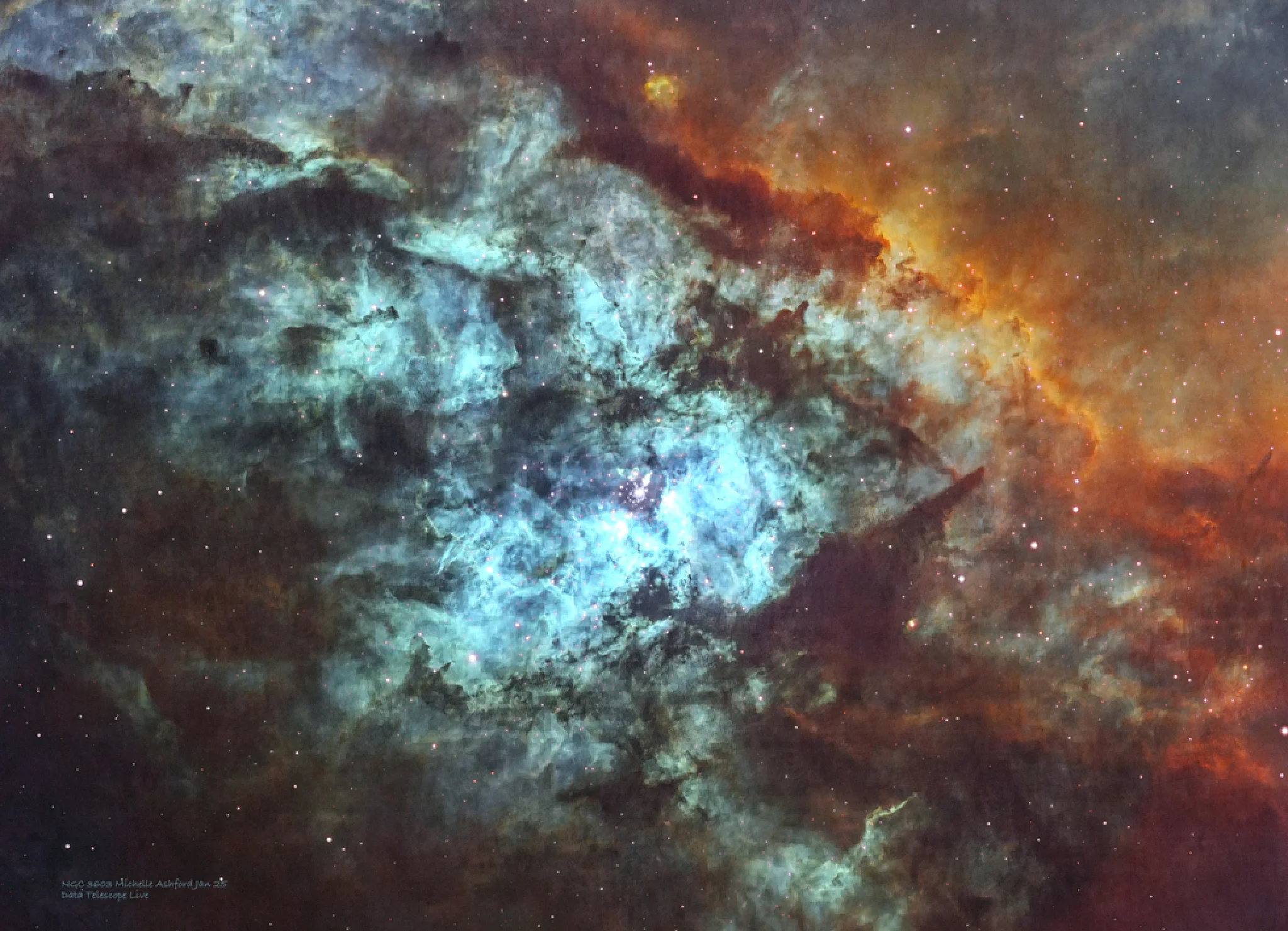
NGC 3603
The giant nebula NGC 3603 is a prominent star-forming region in the Carina spiral arm of our galaxy, about 20,000 light-years away. Discovered by Sir John Herschel in 1834, it is the largest nebula seen in visible light in the Milky Way. Within its core is nestled a stellar "jewel box" of thousands of sparkling young stars, one of the most massive young star clusters in the Milky Way Galaxy.
The cluster is surrounded by clouds of interstellar gas and dust — the raw material for new star formation. Powerful ultraviolet radiation and fast winds from the bluest and hottest stars have blown an enormous cavity in the gas and dust enveloping the cluster. This bubble provides an unobstructed view of the cluster and reveals stages in the life cycle of stars.
Most of the stars in the cluster were born around the same time but differ in size, mass, temperature, and colour. The course of a star's life is determined by its mass, so a cluster of a given age will contain stars in various stages of their lives, giving an opportunity for detailed analyses of stellar life cycles through these family snapshots in time.
NGC 3603 also contains some of the most massive stars known. These huge stars live fast and die young, burning through their hydrogen fuel quickly and ultimately ending their lives in supernova explosions.
NGC 3628
12 credit
- Tipo di obiettivo............................................................................................................................Galaxy
- Fotocamera............................................................................................................................QHY 600M
- Coordinate dell'obiettivo............................................................................................................................RA 170.0709 Dec 13.5895
- Emisfero............................................................................................................................Southern
- Posizione del telescopio............................................................................................................................Chile
- Evento transitorio............................................................................................................................No
- Osservato il............................................................................................................................28 Jan 2023 - 18 Feb 2024
Filtro | Exp. media (s) | Esposizione totale | Sottoframe |
|---|---|---|---|
| Green | 294 | 3h55m | 48 |
| Luminance | 294 | 3h55m | 48 |
| Red | 300 | 4h | 48 |
| Blue | 313 | 4h10m | 48 |