14 Dec 2021
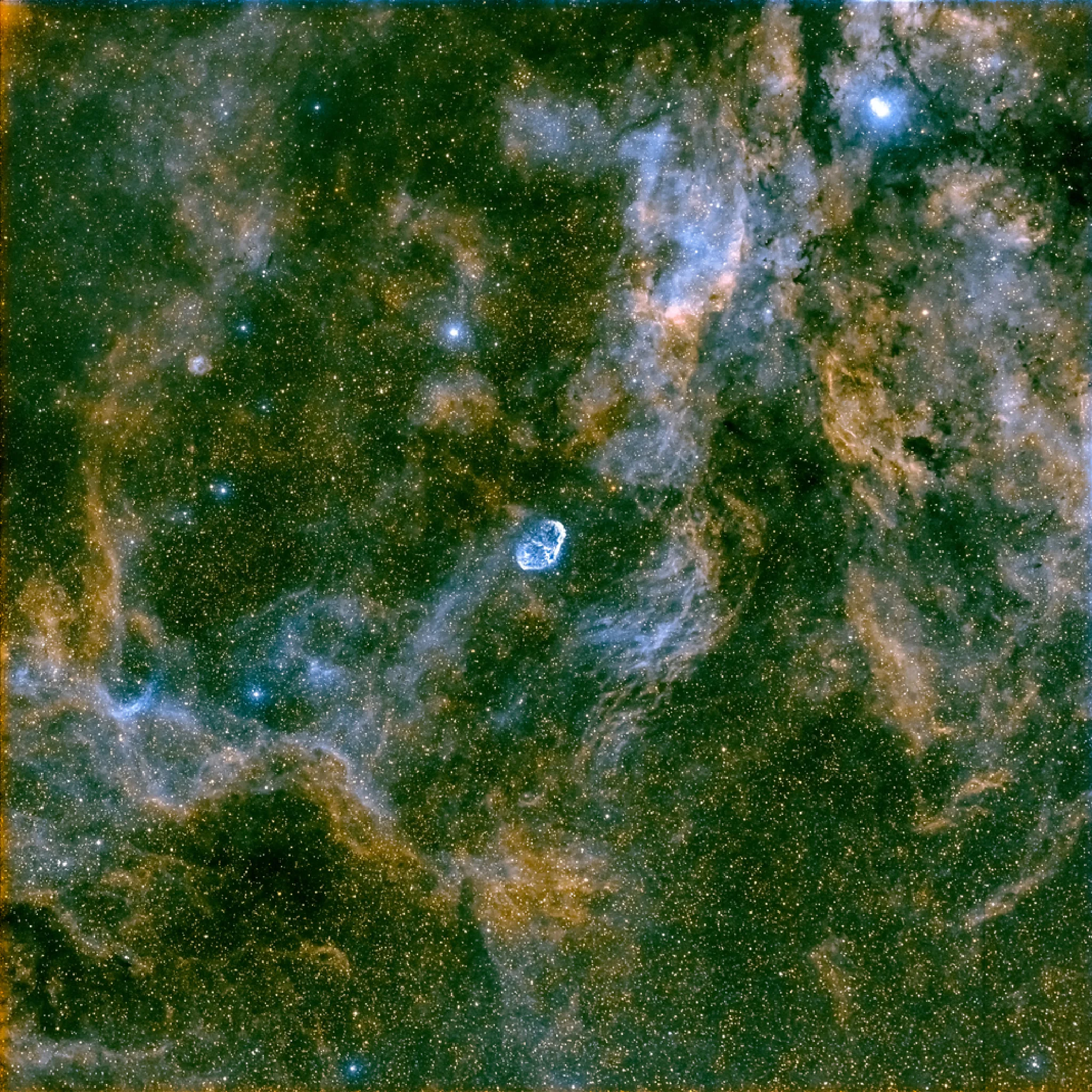
Crescent Nebula - One Click - SPA 3
Crescent Nebula - One Click - SPA 3
Wide Field view
Field of view
324' x 324'
The Crescent Nebula (also known as NGC 6888, Caldwell 27, Sharpless 105) is an emission nebula in the constellation Cygnus, about 5000 light-years away from Earth. It was discovered by William Herschel in 1792.[2] It is formed by the fast stellar wind from the Wolf-Rayet star WR 136 (HD 192163) colliding with and energizing the slower moving wind ejected by the star when it became a red giant around 250,000[3] to 400,000[citation needed] years ago. The result of the collision is a shell and two shock waves, one moving outward and one moving inward. The inward moving shock wave heats the stellar wind to X-ray-emitting temperatures.
It is a rather faint object located about 2 degrees SW of Sadr. For most telescopes it requires a UHC or OIII filter to see. Under favorable circumstances a telescope as small as 8 cm (with filter) can see its nebulosity. Larger telescopes (20 cm or more) reveal the crescent or a Euro sign shape which makes some to call it the "Euro sign nebula".
NGC 6888
8 credit
- Tipo di obiettivo............................................................................................................................Emission Nebula
- Fotocamera............................................................................................................................FLI PL16083
- Coordinate dell'obiettivo............................................................................................................................RA 303.0292 Dec 38.35
- Emisfero............................................................................................................................Northern
- Posizione del telescopio............................................................................................................................Spain
- Evento transitorio............................................................................................................................No
- Osservato il............................................................................................................................28 May 2020 - 10 Jun 2022
Filtro | Exp. media (s) | Esposizione totale | Sottoframe |
|---|---|---|---|
| Halpha | 2530 | 16h10m | 23 |
| Luminance | 8 | 3m | 23 |
| Red | 8 | 3m | 23 |
| Green | 8 | 3m | 22 |
| Blue | 8 | 3m | 22 |