20 Jun 2025
RHO Ophiuchi
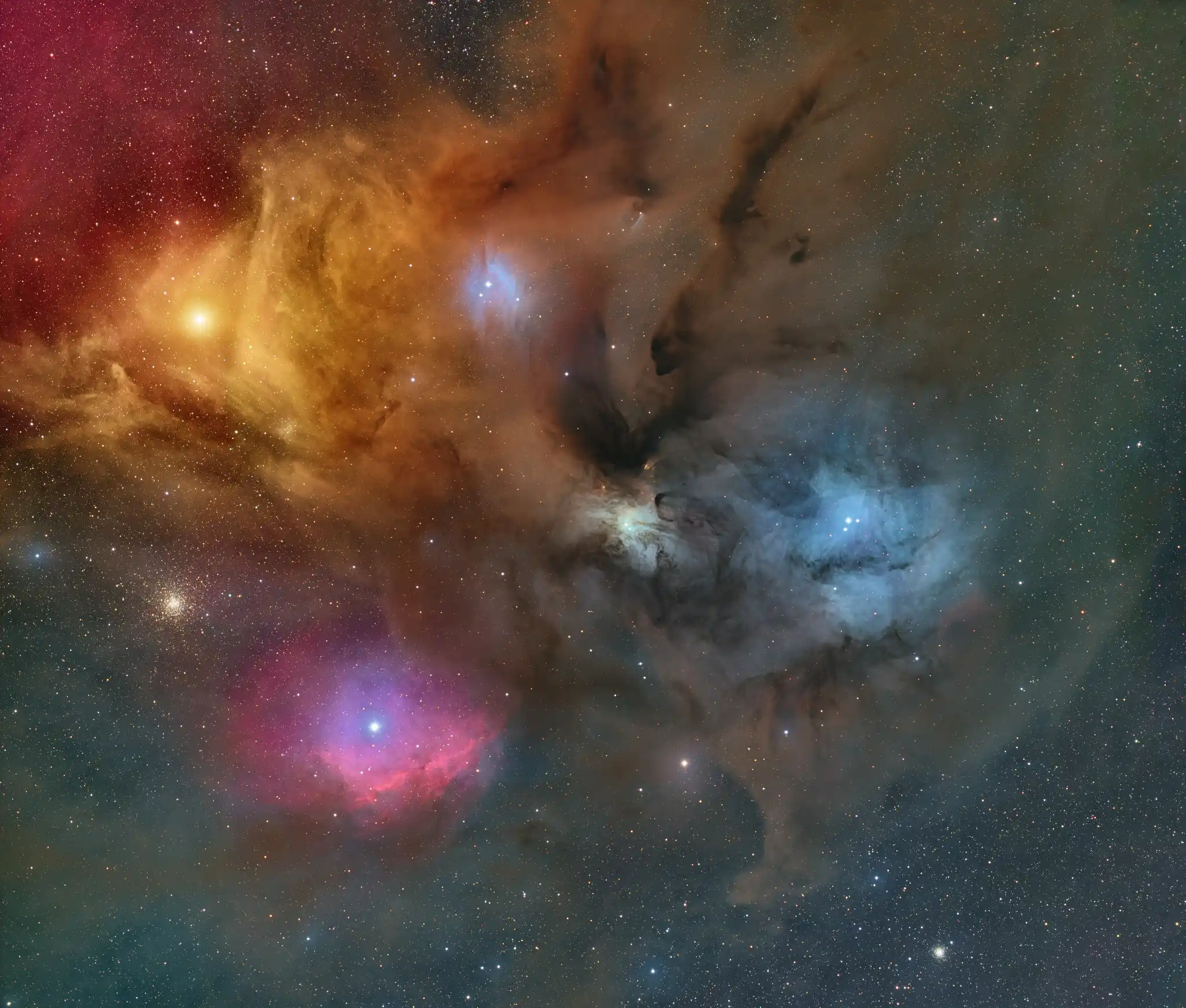
The Rho Ophiuchi region, a breathtaking celestial tapestry located approximately 390 light-years away, is a landmark of modern astrophysics. It is crucial to distinguish between its two primary components: the Rho Ophiuchi (ρ Ophiuchi) multiple star system and the vast Rho Ophiuchi Cloud Complex it inhabits. The star system is a complex, gravitationally bound hierarchy of at least five hot, massive B-type stars. Its brightest members are the engine that illuminates the surrounding nebulosity, creating the brilliant blue reflection nebula IC 4604. The intricate orbits within this multi-star system introduce variability on multiple timescales, making it a dynamic source of energy and feedback.
The cloud complex itself is one of the nearest and most active stellar nurseries to our Solar System. This immense structure of cold gas and dust, with a mass of about 3,000 Suns, is a premier laboratory for studying the birth of low- and intermediate-mass stars like our own Sun. Its proximity allows for unparalleled observational detail. The cloud is not uniform but is composed of dense, star-forming cores, most notably Lynds 1688 (L1688), and vast, weaving filaments of dust known as the Dark River clouds. This structure is believed to have been sculpted by a shockwave from a nearby supernova that occurred over a million years ago, triggering the current burst of star formation. The region is a visual showcase of all major nebula types: blue reflection nebulae (IC 4604), red emission nebulae (Sh2-9), and opaque dark nebulae (L1688).
By peering through the dust with infrared telescopes, astronomers have uncovered the full sequence of early stellar evolution. The L1688 core contains hundreds of young stellar objects, from deeply embedded protostars still gathering mass to more evolved T Tauri stars surrounded by protoplanetary disks—the raw material for future planets. Landmark discoveries in the region include the first confirmed brown dwarf in a stellar nursery and a stunning, edge-on protoplanetary disk nicknamed the "Flying Saucer".
Modern observatories have revolutionized our understanding. The James Webb Space Telescope (JWST) provided a breathtakingly detailed view, revealing the chaotic nature of star birth with powerful jets and outflows erupting from young stars. These images show stellar feedback in action, as massive stars carve out cavities in the surrounding gas, and provide clear evidence of protoplanetary disks seen in silhouette. In parallel, radio telescopes like ALMA have turned the region into a chemical frontier, detecting complex organic molecules like the simple sugar glycolaldehyde around a young protostar, demonstrating that the chemical precursors to life exist at the earliest stages of planet formation.
Finally, comparing Rho Ophiuchi to the more famous Orion Nebula highlights its unique scientific value. While Orion is a violent cauldron of high-mass star formation, Rho Ophiuchi represents a more common, "quiescent" mode of low-mass star birth. This makes it a more representative model for how the majority of stars in our galaxy, including the Sun, likely formed, cementing its status as a cornerstone for understanding our own cosmic origins.
Rho Ophiuchi
17 credit
- Tipo di obiettivo............................................................................................................................Reflection Nebula
- Fotocamera............................................................................................................................FLI PL16803
- Coordinate dell'obiettivo............................................................................................................................RA 246.3963 Dec -24.94694
- Emisfero............................................................................................................................Southern
- Posizione del telescopio............................................................................................................................Australia
- Evento transitorio............................................................................................................................No
- Osservato il............................................................................................................................12 Mar 2021 - 28 Aug 2021
Filtro | Exp. media (s) | Esposizione totale | Sottoframe |
|---|---|---|---|
| Luminance | 807 | 6h30m | 29 |
| Red | 786 | 6h20m | 29 |
| Green | 745 | 6h | 29 |
| Blue | 621 | 5h | 29 |
| Halpha | 21 | 10m | 28 |