05 Mar 2022
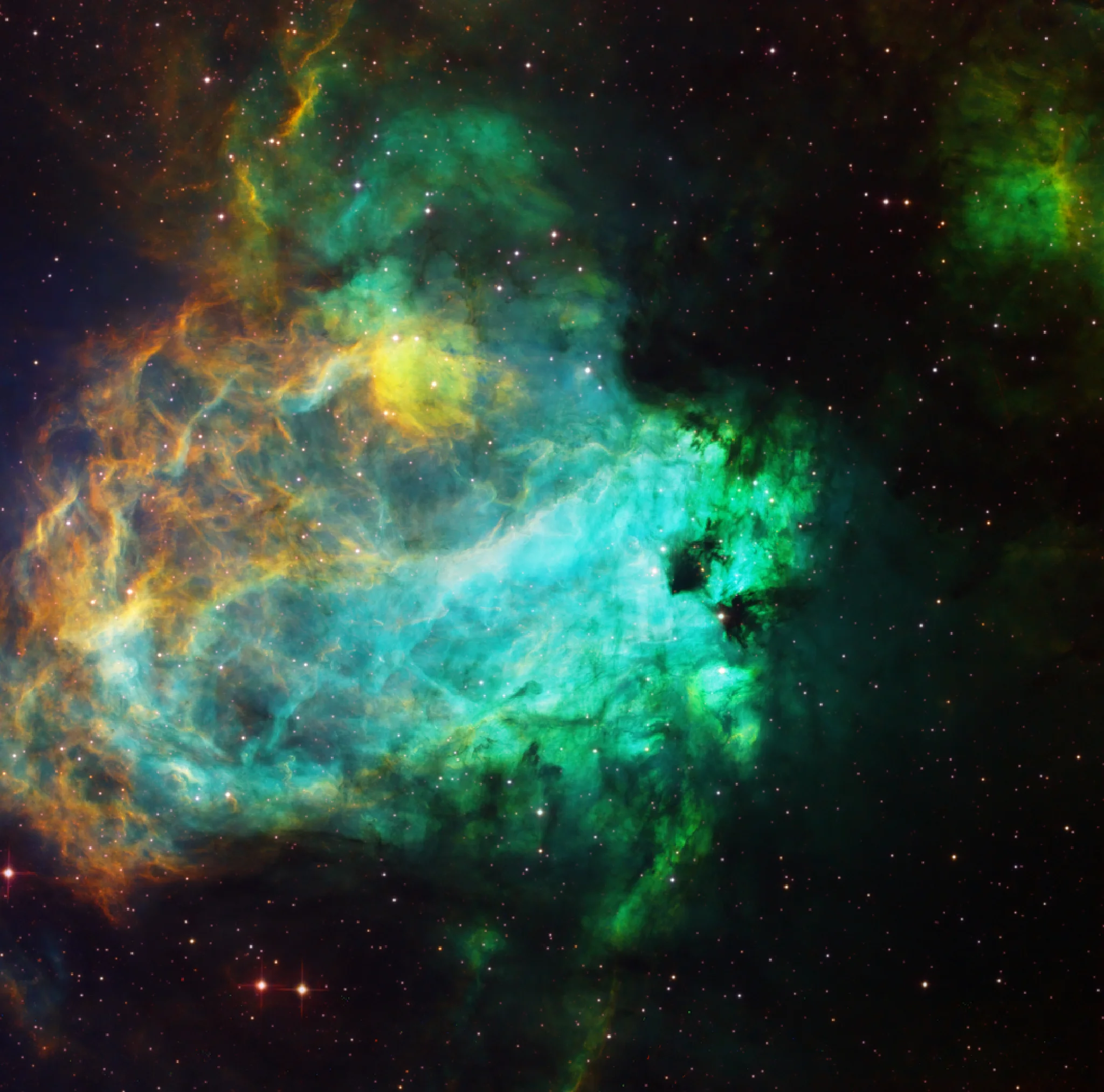
NGC6188 /M17/Omega/Swan Nenula
Illuminated by ultraviolet radiation from young, massive stars on the right side of this photograph, M17, also known as the Omega Nebula or Swan Nebula, is one of the largest star-forming regions in the Milky Way galaxy. Hubble’s stunning image of a central portion of the nebula has been colorized to highlight certain wavelengths of light. Green represents oxygen while red reveals hydrogen and infrared light.
The Omega Nebula was discovered in 1745 by the Swiss astronomer Jean-Philippe Loys de Chéseaux. It is located 5,500 light-years from Earth in the constellation Sagittarius. The nebula has an apparent magnitude of 6 and can be seen with a pair of binoculars. M17, which appears near M16 and M18 in the sky, is best viewed on clear nights in August.
M17 contains one of our galaxy’s youngest star clusters, at only 1 million years old. However, many of the young stars in this cluster are impossible to see because of the gas and dust that surrounds them. The powerful radiation from the young stars evaporates and erodes the dense clouds of cold gas in which new stars form. One such pocket of gas is seen at the center of the brightest region of the nebula (near the top right of this image) and is about 10 times larger than our solar system.
M16
17 credit
- Tipo di obiettivo............................................................................................................................Emission Nebula
- Fotocamera............................................................................................................................FLI ProLine PL9000
- Coordinate dell'obiettivo............................................................................................................................RA 274.7 Dec -13.8
- Emisfero............................................................................................................................Southern
- Posizione del telescopio............................................................................................................................Chile
- Evento transitorio............................................................................................................................No
- Osservato il............................................................................................................................22 Mar 2020 - 08 Oct 2022
Filtro | Exp. media (s) | Esposizione totale | Sottoframe |
|---|---|---|---|
| Luminance | 91 | 1h20m | 53 |
| Halpha | 1211 | 17h50m | 53 |
| Red | 86 | 1h16m | 53 |
| Green | 93 | 1h22m | 53 |
| Blue | 88 | 1h16m | 52 |