11 Jul 2025
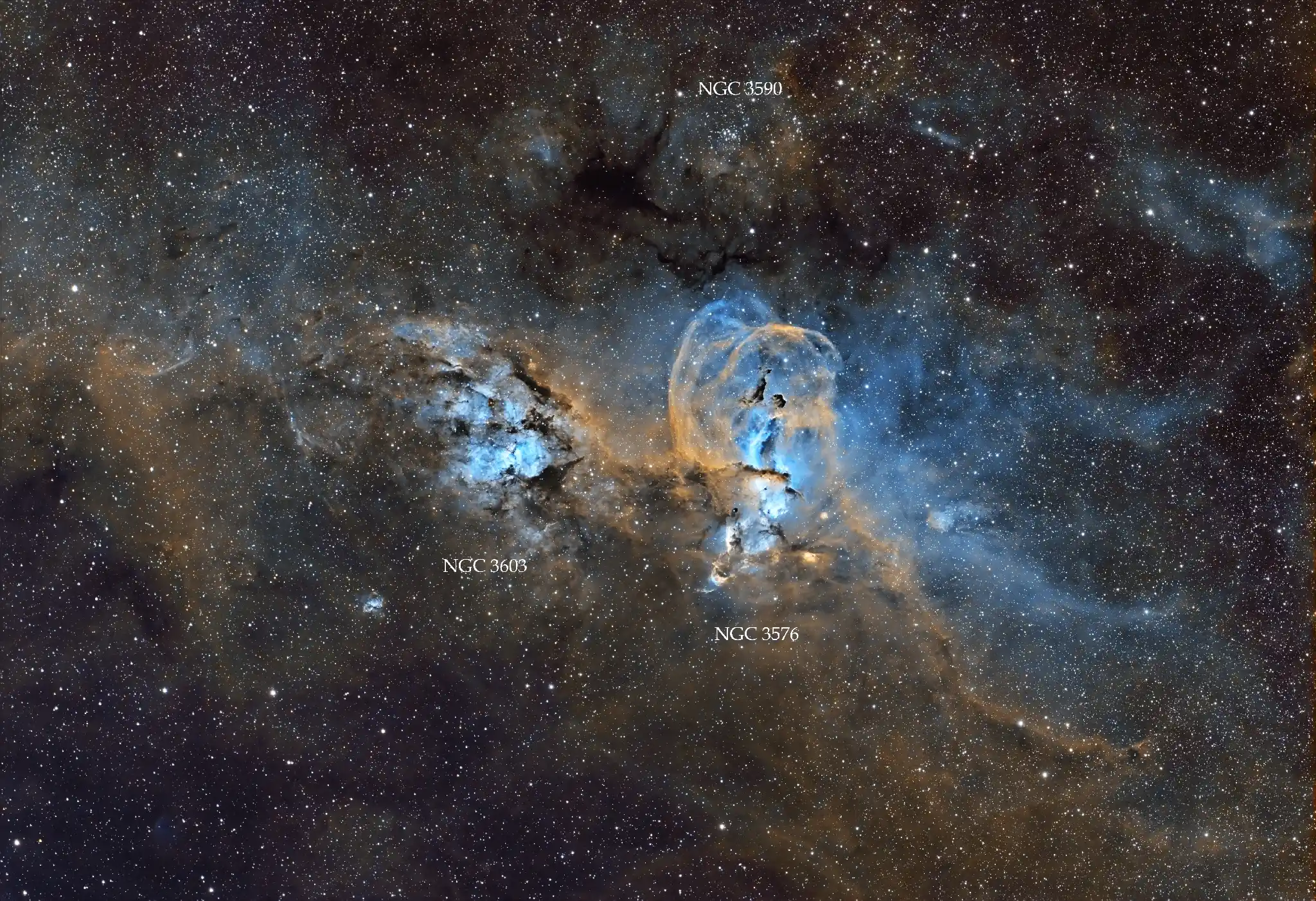
NGC 3603 (Giant Nebula) + NGC 3576 (Statue of Liberty)
Approximately 4° ESE from the impressive Carina Nebula is a small wispy area which is consistently studied as a star forming region. The first nebula is identified as NGC 3603, while the second nebula is a complex of 6 NGC objects (3576, 3579, 3581, 3582, 3584 and 3586) that has a general identifier of NGC 3576. In 1834, observing from the Cape of Good Hope, John Herschel was very impressed by the variety of nebulous forms in this region.
The distance to the 2 nebulae is somewhat difficult to determine, due to the reddening and dust obscuring environment. NGC 3576 is estimated to be 9.100 light-years away, while NGC 3603 is more than twice further, at 22.100 light-years.
NGC 3603 is often classified as a magnitude 9 open cluster, but even short exposures reveal the HII region surrounding it. The dark lanes crossing the nebula forms a giant’s silhouette, giving it the same nickname – Giant Nebula. One wouldn’t know judging by visual standards, but this nebula is one of the biggest and most massive HII regions in the galaxy. Like others of its size, it is obscured by dust at optical wavelengths. Fortunately, the central stars, even reddened by 4 magnitudes of foreground extinction, can be clearly seen and observed at optical wavelengths. Of the entire Carina complex, it is the youngest and most abundant in nascent stars, dense cores, water and methanol and both infrared and X-ray sources. NGC 3603 is considered a clone of the supermassive cluster R136 at the core of the Tarantula Nebula in the Large Magellanic Cloud, both containing extremely massive stars of the same age. Around the nebula there is a super bubble measuring 330 light-years, most likely created by the outflow from the central cluster. The expansion speed of this bubble is around 100 km/s. The real action happens, however, deep in the nebula. Far-infrared observations by the Herschel Space Observatory revealed more than 100 embedded point sources, looking like YSO (young stellar objects). Most of these YSOs are younger than 4000 years. The strong radiation field generated by the central cluster created waves of starburst activity as it travels through the nebula.
NGC 3576 is a prime example of a massive star cluster forming along the boundary of a giant molecular cloud. The cluster is less than 1 million years old and contains more than 50 stars earlier then spectral type A0. Most of them also show an infrared excess, evidence of circumstellar disks still present. Across the nebula, there is a temperature gradient that increases from east to west, consistent with the infrared gradient. There appears to be a large-scale ionized flow which may contribute to the large loops and filaments seen in the NE part of the nebula at visual wavelengths. The contrast between the gaseous filaments and the dusty areas also created here a silhouette very similar to the Statue of Liberty in New York. The star cluster – identified as HD 97950 – seems to have formed all at once during an intense starburst episode covering less than 7 light-years in diameter. These stars are Wolf-Rayet type of which many are heavier than 100 solar masses.
NGC 3572 & NGC 3579
8 credit
- Tipo di obiettivo............................................................................................................................Emission Nebula
- Fotocamera............................................................................................................................QHY 600M
- Coordinate dell'obiettivo............................................................................................................................RA 166.5235 Dec -60.6522
- Emisfero............................................................................................................................Southern
- Posizione del telescopio............................................................................................................................Australia
- Evento transitorio............................................................................................................................No
- Osservato il............................................................................................................................19 Dec 2024 - 25 Dec 2024
Filtro | Exp. media (s) | Esposizione totale | Sottoframe |
|---|---|---|---|
| Halpha | 356 | 4h45m | 48 |
| SII | 294 | 3h55m | 48 |
| OIII | 250 | 3h20m | 48 |